




Christmas is, at its heart, the Christian celebration of God becoming human in the birth of Jesus Christ—and, over time, it has also become a global cultural festival woven from scripture, theology, empire politics, winter traditions, and a lot of storytelling.
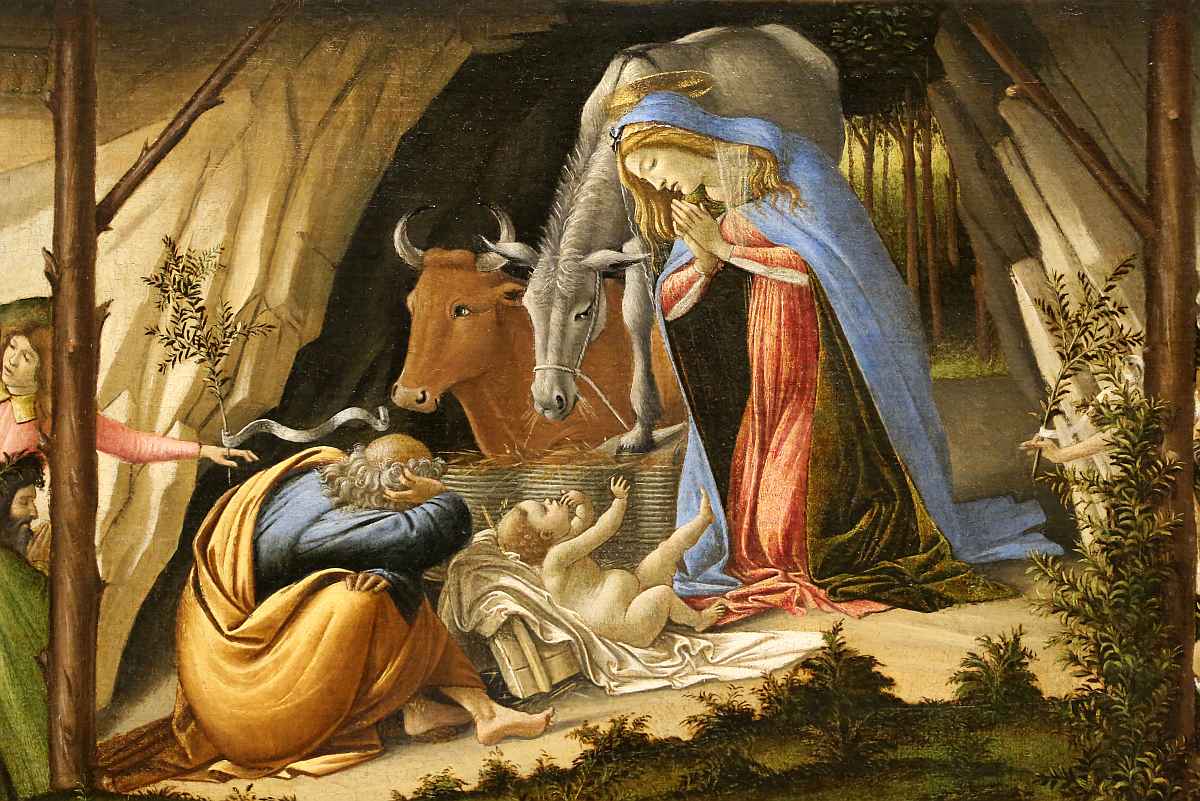
Sandro Botticelli (1445–1510) – Mystic nativity
What “Christmas” Means
The name itself
The word “Christmas” comes from Old English Crīstesmæsse—“Christ’s Mass”—first recorded in the 11th century. It literally refers to the Eucharistic service (Mass) celebrating the birth of Christ. “Christ” comes from the Greek Christos, translating the Hebrew Mashiach (Messiah, “anointed one”).
So built into the word is the claim: this child is the promised king; this feast is his liturgical celebration.
The Christian meaning
For Christianity, Christmas is not just “Jesus’ birthday party.” It centers on the doctrine of the Incarnation: that the eternal Son of God takes on real human nature.
Key themes bound up in that:
- “God with us” (Emmanuel) – God is not distant; he steps into human history, vulnerability, poverty, political tension, and family life.
- Revelation of God’s character – In the manger, God is shown as self-giving, humble, approaching us without coercion.
- Hope and salvation – The birth in Bethlehem is the beginning of the story that leads to the cross and resurrection; Christmas looks forward to Easter.
- Dignity of human life – If God takes on human flesh, then human bodies, the poor, the marginalized, and everyday life are given profound worth.
- Joy, peace, generosity – Christian tradition links Christmas to reconciliation, hospitality, and gift-giving as a response to God’s “gift” of Christ.
Even for people who aren’t religious, modern Christmas often carries echoes of these themes: family closeness, concern for the lonely, charitable giving, and a stubborn belief that light belongs in the darkest time of year.
How Christmas Originated
The New Testament doesn’t give a date
The Gospels of Matthew and Luke tell the story of Jesus’ birth—Mary and Joseph, Bethlehem, the manger, angels, shepherds, the visit of the Magi—but they never mention a date and never command a yearly birthday feast.
For the first couple of centuries, Christians focused liturgically more on Easter (death and resurrection) than on Christmas.
The first clear celebrations
By the 3rd–4th centuries, Christians in different regions began to mark Christ’s birth:
- In the East (e.g., Egypt/Asia Minor), there is evidence of a celebration on January 6, a combined feast of Christ’s birth and baptism (Epiphany/Theophany).
- In the West (Rome), by AD 336, documents like the Chronograph of 354 list a feast of the Nativity of Christ on December 25.
Over time, traditions differentiated:
- Western churches: December 25.
- Many Eastern Orthodox churches using the Julian calendar: the same liturgical date (Dec 25) which falls on January 7 in the modern civil (Gregorian) calendar.
- The Armenian Apostolic Church: keeps the more ancient pattern of celebrating on January 6.
Why December 25?
This is the fun—and occasionally controversial—part. There are two major explanatory lines, and historians debate how much each mattered.
1. The “calculation theory” (internal Christian logic)
In late antique Christian thought, there was a tradition that great prophets died on the same date as their conception. Some early sources placed Jesus’ crucifixion on March 25 (in the Roman calendar). From that:
- If Jesus was conceived on March 25 (eventually celebrated as the Annunciation), then
- Nine months later is December 25—voilà, date for his birth.
This view suggests December 25 arose from Christian theological symbolism and calendar math, not from borrowing a pagan feast. Many scholars see solid evidence for this line of reasoning in early Christian texts.
2. The “solstice / pagan festival” theory
The Roman world already had lively celebrations around the winter solstice:
- Saturnalia (Dec 17–23): feasting, gift-giving, role reversals.
- Dies Natalis Solis Invicti (“Birthday of the Unconquered Sun”), associated with the sun god and observed on December 25 from the late 3rd century.
Because of this, many have argued the church placed Christmas on December 25 to compete with or “baptize” popular pagan festivals—presenting Christ as the true Sun, the light in the year’s darkest season.
However:
- Evidence is mixed and later writers may be projecting motives backwards.
- Some modern scholarship argues that the Christian date may have been established independently and that the Sol Invictus feast’s prominence on Dec 25 is itself complicated.
Most responsible historians today would say:
The December 25 date likely reflects both Christian theological symbolism tied to the equinox/Annunciation and a meaningful convergence with existing solstice imagery in Roman culture, without a simple “they stole it” storyline.
So… is Christmas “pagan”?
Short answer: no, not in its core meaning.
- The central content of Christmas—celebrating the Nativity of Jesus, the Incarnation—is thoroughly Christian.
- Some customs (evergreens, Yule logs, certain folk practices) draw from older European winter traditions; others (gift-giving, lights, feasts) are shaped by both Christian symbolism and broader cultural habits.
- Over centuries, as Christianity spread, local cultures layered their own imagery, foods, and legends (e.g., St. Nicholas/Santa Claus).
So Christmas, as actually practiced, is a hybrid cultural phenomenon built around a distinctly Christian theological center.
How the meaning has expanded today
In much of the world, Christmas now works on two intertwined levels:
- Religious festival
- Worship services, readings of the Nativity story, carols, prayer.
- Reflection on God’s nearness, humility, and love for the vulnerable.
- Cultural & family holiday
- Time off work, shared meals, exchanging gifts, decorations, movies.
- For many non-Christians, it’s a season about generosity, wonder for children, and reconnecting with people.
Critiques are ancient too: reformers, pastors, and writers have complained (for centuries) about excess drinking, commercialism, and forgetting the poor. That tension—between deep spiritual claim and noisy consumer spectacle—has been part of Christmas for a very long time.
In one sentence
Christmas began as the Christian feast of Christ’s birth—rooted in the belief that God became human in Jesus—and took shape in the 3rd–4th centuries around December 25 (and January 6 in the East), gradually absorbing and transforming surrounding winter customs until it became both a major religious holy day and a global cultural celebration.
If you’d like, next step I can:
- zoom in on the biblical Nativity accounts,
- unpack the “Xmas vs Christmas” thing, or
- trace how Santa, trees, and gifts fit into this story.

Christmas Holidays
Discover the Magic of the Season – An enriching journey through traditions, history, and the joy of Christmas
Discover more from MultiMedia
Subscribe to get the latest posts sent to your email.




Leave a Reply