




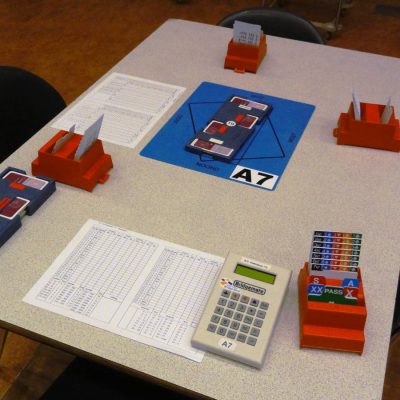
To learn bridge, we must first become familiar with the physical elements of the game: the table, the positions of the four players, the partnerships, the deck of cards, and the way the cards are dealt.
Bridge is played with a standard 52-card deck, without jokers. Four players take part, grouped into two partnerships. Each player receives 13 cards, so the entire deck is dealt.
The position of each participant at the table is important. The players are identified by the four points of the compass: North, East, South, and West. North and South form one partnership, while East and West form the other.
These names are used constantly in bridge books, diagrams, tournaments, and online platforms. It is therefore useful to become familiar with them from the very beginning.
A bridge deal has two main stages:
- the auction, during which the contract is established;
- the play of the cards, during which the players try either to make or defeat the contract.
Before the auction begins, we must know who the dealer is, meaning the first player entitled to make a call. In competitive bridge, we must also know the vulnerability, because it affects the scoring.

The Four Players and the Points of the Compass
At bridge, the four players are identified by the points of the compass:
- North, abbreviated N;
- East, abbreviated E;
- South, abbreviated S;
- West, abbreviated W.
The players are seated as follows:
- North sits opposite South;
- East sits opposite West;
- North has East on the left and West on the right;
- South has West on the left and East on the right.
A simplified representation of the table is:
NORTH
WEST EAST
SOUTH
Naturally, each player sees the table from a different perspective. For the player sitting South, North is the partner sitting opposite, West is the opponent on the left, and East is the opponent on the right.
In many books for beginners, declarer’s hand is shown at South and dummy’s hand at North. This is only a graphical convention chosen to make it easier for the reader to see both hands. In an actual game, any of the four players may become declarer, dummy, or a defender.
The auction and the play proceed clockwise. If North is the first player to bid, East follows, then South, then West, after which it is North’s turn again.
The order is therefore:
North – East – South – West – North
The same principle applies during the play of the cards. After one player places a card on the table, the next player, seated to that player’s left, plays a card, followed by the next player, and so on.
Each participant must act only when it is their turn. A call or card played out of turn may constitute an irregularity. In a friendly game, the situation can usually be corrected easily. In a tournament, the director should be called to apply the relevant rule.
The compass names are useful because the players’ positions remain clear regardless of where the table is located. There is no need to say “the player on the left” or “the person opposite.” We can simply say:
- North opened the auction;
- East overcalled;
- South became declarer;
- West made the opening lead.
In bridge diagrams, the hands are placed according to their positions at the table. For example:
NORTH
♠ A 8 4
♥ K 10 5
♦ Q 9 7
♣ J 6 3 2
WEST EAST
SOUTH
♠ K Q 10 7 2
♥ A 8 4
♦ A 6 3
♣ 9 5
In such a diagram, the reader usually sees only the hands relevant to the explanation. Sometimes all four hands are shown, while at other times only declarer’s hand and dummy’s hand are presented.
In English-language notation, the honor cards are written as:
- A for ace;
- K for king;
- Q for queen;
- J for jack.
Beginners should become comfortable with this notation because it is used in most international books, tournaments, and online platforms.
The positions North, East, South, and West do not indicate the permanent value or role of a player. They show only the player’s seat at the table. The roles change from one deal to another according to the auction.
On one deal, South may become declarer and North may become dummy. On the next deal, East may become declarer, West may become dummy, and North and South will defend.
Discover more from MultiMedia
Subscribe to get the latest posts sent to your email.




Leave a Reply