




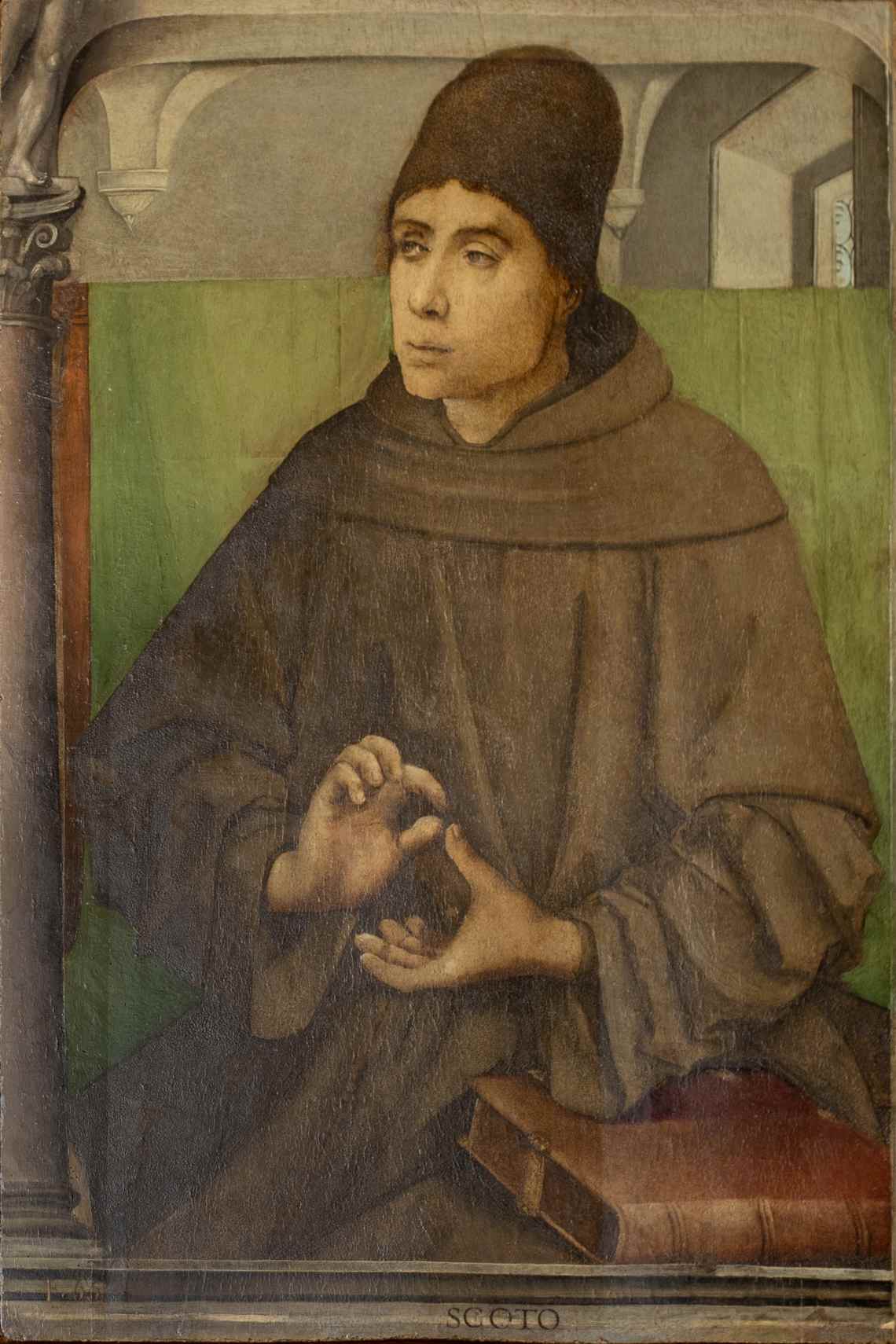
As he makes matter an actual reality even without form, and the individual a positive reality distinct from the species, Duns Scotus gives to the possible intellect an activity which is, to a certain extent, autonomous, with respect to – vis-à-vis the agent intellect: the proper role of the agent intellect is to separate the specific form from the sensible image where it is in power; but that of the possible intellect is the act of understanding, and of this act it is the total cause; the intelligible species, product of abstraction, is required not to produce the act of understanding, which derives from the possible intellect alone, but to determine this act to this or that object4. He still believes that the distinction of acts is only made manifest by that of objects, although, in itself, it arises from intellectual power alone. We also see to what extent this theory separates Duns Scotus from Augustinian Illuminism; to the thesis of Henry of Ghent, that sensitive objects cannot enlighten the soul and that a ‘divine ray’ is needed, he replies by citing the certainty of the first principles which are apprehended with evidence, as soon as the terms Te are, certainty by experience, finally the interior certainty of the facts of consciousness, so many examples of direct and autonomous certainties.
It is in the same spirit that he asserts against the Thomists the primacy of the will over the understanding. Although it in no way disdains the dictates of right reason, the will can “command the understanding”, by directing it to the consideration of this or that object; “the understanding, if it is the cause of volition, is therefore a cause subject to the will”. What Duns Scotus aims at is not to replace Thomism with the Augustinian view which makes love rather than knowledge the final goal of things, it is to free the will from the understanding, as he freed matter from form, the individual from species, the intellect from divine illumination; for these considerations result above all in declaring that the will is entirely free: “Nothing, other than the will, is the total cause of volition in the will. »
It is these psychological views that Duns Scotus carries into theology. No enslavement, with God either, of his will to a good conceived by his understanding. Without doubt, the possibilities that God conceives through his understanding are not arbitrary decisions of his will, and Duns Scotus never taught the creation of eternal ideas in the Cartesian sense. He holds that the divine will is always reasonable. But essences do not pre-exist willing as unconditional rules: “There is no cause of the fact that his will has willed such and such a thing, except that the will is the will,” and “no rule is right except in as long as it is accepted by the divine will.”
Thesis which has important consequences on the spirit of Scotist morality. The moral precepts which make us know the good depend on a divine law; but this good comes first of all from the fact that they were willed by God; and, as divine omnipotence (potentia absoluta) – which is a given of faith – has no other limit than non-contradiction, only the first commandments of the Decalogue. The others, which concern duties towards contingent creatures, could have been different and are only valid through their express notification. Obligatory by potentia conditionata, they could and will still be able to be modified by divine decision, with a view to a greater good.
This radical discontinuity that Duns Scotus introduces into divine reality governs his conception of politics. For him, only the family is a society of “natural law”. Other human groups are based on a free contract (election and consensus). The original community of goods having been abrogated after sin, the authorities established by the social pact can regulate the regime of property and the law of exchanges in the common interest, without reference to a supposedly immutable “law of nature”. This doctrine gives a large place to freedom and human industrialism, and announces modern democratic theories in several ways.
The voluntarism of Duns Scotus took a much more radical form in a 14th century Oxfordian, Thomas Bradwardine, who, born before 1290, died Archbishop of Canterbury in 1349. A mathematician and as such he appreciated the Anselmian proof of the existence of God that he only wants to complete by demonstrating that the concept of the sovereignly perfect being does not imply contradiction, he was above all the antipelagian who almost came to deny any causality other than divine causality; not only is there for him “no reason or law necessary in God prior to his will”, but also “the divine will is the efficient cause of everything whatever it may be, the driving cause of everything movement”, and the freest act that man can do, it is God who requires it..
This theory of the serf-arbitrator, so dry, so far from mysticism, since, far from uniting man to God through meditation and love, he makes him depend on him externally as a serf depends of his master (“Man is a serf of God, a spontaneous serf, I say, and not constrained”)., spread in the 14th century; she is represented at the University of Paris by the Cistercian Jean de Mireçourt who, in 1347, saw forty of her theses condemned, including those which said that “God wants someone to sin and to be a sinner, that ‘he wants, by wanting his bifen, that he is a sinner, that he is the cause of sin as sin, of guilt as guilt, author of sin as sin.” Theological determinism which, through the Englishman John of Wyclef, influenced Luther. Scotism which, in the 14th and 15th centuries, had so many commentators and even chairs dedicated to teaching it in the main universities of Europe, thus contributed in several ways to the creation of a new spirit.
Source: Émile Bréhier (1951). Histoire de la philosophie, Presses Universitaires de France. Translation and adaptation by © 2026 Nicolae Sfetcu

Heavy Water: A School of Romanian Scientific and Technological Research, a Paradigm in Kuhn’s Sense
A powerful insider’s chronicle of Romania’s most ambitious scientific and technological project: the development of heavy water production for nuclear energy.

The Adventures of Pinocchio – A story for adults
Unveiling a Timeless Masterpiece for Modern Times
Philosophy – Basic Notions, Volume 2
Covers ethics, politics, culture, mind, science, and art through diverse philosophical lenses.
Discover more from MultiMedia
Subscribe to get the latest posts sent to your email.


Leave a Reply