




Bridge can be played in several ways. Some players prefer it as a recreational activity among friends or family. Others take part in organized competitions in clubs, online, or under the authority of national and international federations.
Recreational bridge emphasizes enjoyment and social interaction. Four people may meet to play several deals without strict tournament procedures or a complex method of comparing results.
This form is suitable for beginners because it allows learning at a relaxed pace. Players can discuss a deal after it is over, analyze the auction, and explain certain decisions. The main purpose is an enjoyable experience and gradual improvement.
Recreational bridge should not, however, be confused with a game without rules. Even in a friendly game, participants should respect the order of bidding, the obligation to follow suit, and the other fundamental principles. Observing the rules helps players develop correct habits.
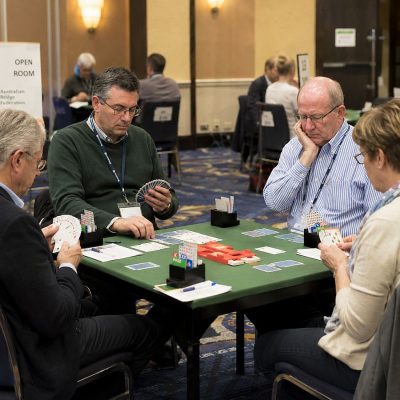
Competitive bridge, usually known as duplicate bridge, uses a special method designed to reduce the influence of luck. The same hands are played by several partnerships under comparable conditions.
In a tournament, the cards are not shuffled after every play. They are kept in the pockets of a special holder called a board and moved to other tables. In this way, several participants play exactly the same deal.
A partnership’s result is not assessed only by the number of points scored on that deal. It is compared with the results achieved by the other partnerships that held the same cards and played in the same direction.
Suppose a partnership receives very weak cards. In an ordinary game, the players might think that they were simply unlucky. In duplicate bridge, all the other partnerships sitting in the same direction receive the same weak cards. The winning partnership is the one that obtains a better result than the others in the same situation.
It may not be possible to win the hand, but the partnership may limit the loss. It may prevent the opponents from reaching their best contract, find the most effective opening lead, or avoid an excessive penalty. A modest result may become an excellent one when compared with the results obtained at the other tables.
For this reason, in competitive bridge it is not important merely to hold good cards. What matters is playing them better than the other players who received exactly the same cards.
Competitions may be organized under several scoring formats. The most common are pairs events and team matches.
In pairs competitions, each result is compared with the results of the other partnerships. Even a small difference may be important. One extra trick or one penalty avoided may significantly affect the score on a board.
In team matches, two partnerships form a team. The same deal is played in two rooms or at two tables, with the directions reversed. The results are then compared and converted into a special form of scoring. In this type of competition, making the contract safely is often more important than winning one extra trick.
Competitive bridge has clear rules concerning conduct, time limits, explanation of conventions, and the correction of irregularities. The tournament is supervised by a director, whose role is not simply to punish players but to apply the laws and restore fairness when a problem occurs.
Beginners should not be afraid of competitions. Many clubs organize events for new players, and the atmosphere is usually friendly. Taking part in tournaments can speed up learning because the player encounters a wide variety of situations and can compare personal decisions with those of other partnerships.
Bridge is also widely played online. Bridge platforms make it possible to organize friendly games, competitions, and lessons. Players can meet partners and opponents from all over the world.
Online play is useful for practice because it allows frequent play and access to a large number of deals. Nevertheless, the experience of playing at a physical table remains important. It helps players understand the pace, etiquette, and atmosphere specific to bridge.
Discover more from MultiMedia
Subscribe to get the latest posts sent to your email.



Leave a Reply