Free will
Free will is the faculty that the human being would have to determine himself freely and by him alone, to act and to think, as opposed to determinism or fatalism, which affirms that the will would be determined in each … Read More
Book publishing is the ‘oldest’ of the media and content industries, as it can be traced back to the 1st century AD when the modern book format was introduced. The codex, a book made of a number of sheets of … Read More
Logical empiricism (sometimes called logical empiricism, neo-positivism, or rational empiricism) is a philosophical school primarily exemplified by the Vienna Circle, founded by a group of Viennese scientists and philosophers in the 1920s. The Vienna Circle was above all a place … Read More
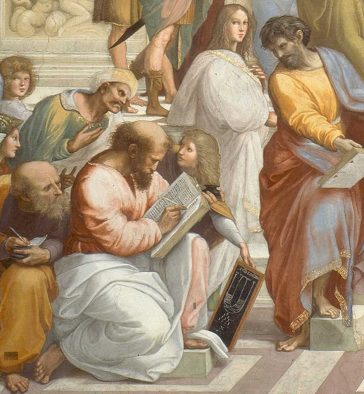
The Pythagorean school founded by Pythagoras (580-495 BC) in Magna Graecia constitutes a brotherhood that is both scientific and religious: Pythagoreanism is indeed based on an initiation and offers its followers a way of ethics and food life, as well … Read More
There was a time, when it was, that if it weren’t, it wouldn’t be told. We haven’t been since the stories, but we’ve been there for about two or three days, since the flea was shod with ninety-nine iron goats … Read More
The philosophy of logic is a part of the philosophy of science which is interested in the set of theoretical problems which traditionally come under logic, essentially comprising first of all the question of its essence, its history from its … Read More
(Monkeys as Judges of Art, 1889, Gabriel von Max.) Art criticism is the value judgment expressed on works of art in the field of aesthetics, but also with regard to their relevance in a given social and political context. Art … Read More
In philosophy of mind, functionalism is a theory which, for methodological reasons, conceives of the mind as an information processing system and compares thought to a computation (Hobbes conceived the reason this way). Resulting from research in artificial intelligence, functionalism … Read More
Abraham Rudnick Introduction Societies are measured in part in relation to how they rise to the occasion of collective crises and learn from them. For example, both Taiwan and Canada (specifically Toronto) were similarly directly impacted by the Severe Acute Respiratory … Read More
(Excerpt) In ancient times, when people, as they are today, were only in the germs of the future, when God was still treading with his holy feet the stony deserts of the earth, – in ancient times lived a thoughtful … Read More
Cogito, ergo sum is a Latin phrase meaning “I think, therefore I am”. Used by the philosopher and mathematician René Descartes in the Discourse on the Method (1637), the formula has a variant in his work in 1641, in the … Read More