




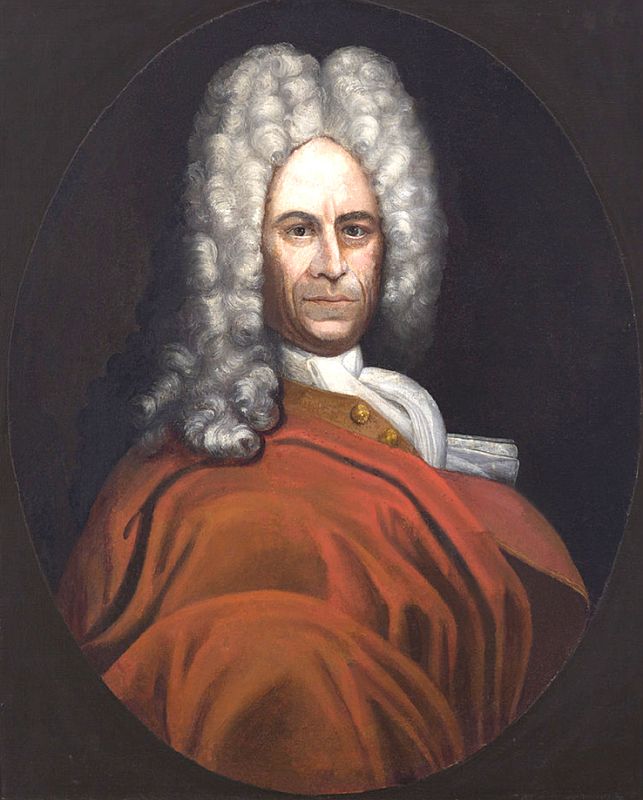
 Christian Wolff (1679-1754) is one of the few renowned philosophers of his time who taught philosophy regularly in universities: his books are lectures and manuals. He was a professor in Halle in 1706, he was dismissed in 1723 by Frederick William, at the request of his Pietist colleagues Francke and Lange; he taught in Marburg; he was then reinstated in his chair at Halle in 1740, upon the accession of the great Frederick. On the surface, the doctrine of this disciple and popularizer of Leibniz is an exception to this clear shift that we have seen everywhere at the beginning of the 18th century: in a series of treatises first written in German (Vemünfiige Gedankm von Gott, der Welt, und der Seele, auch allen Dingen überhaupt, 1719, V. G. von der Menschen Tun und Lassen, 1720, V. G. von dem gesellschaftlichen Leben der Menschen, 1722) then in Latin (Philosophia rationalis sive logicà, 1728, Philosophia prima sive ontologia, 1729; Cosmologia generalis, 1731; Psychologia empirica, 1732; Psychologia rationalis, 1734; Theologia naturalis, 1736-1737: Jusnatùrae, 1740-1748; Jus gentium, 1750; Philosophia moralis, 1750-1753; Economica, 1750), he gave German philosophy its language, its program, and its methods for a long time.
Yet this teaching was imbued with the spirit of the times: if he was dismissed in 1723, it was because of the disquiet caused by his intemperate determinism, and for his Discourse on the Practical Philosophy of the Chinese, in which he places Confucius, along with Jesus Christ, among the prophets. We know what success China was beginning to have among philosophers since the Jesuit missionaries had made it known, for example in their Confucius, Sinarum philosophas, in whom they declared to find a morality “infinitely sublime, simple, sensitive, and drawn from the pure sources of natural reason.”[1] The admission came at the right time to serve the philosophers who affirmed the existence of a morality independent of any belief in God. It is one of Wolff’s concerns (who, on this point, departs well from Leibniz) to find rules of action that would retain their value even if God did not exist; his essential rule: “Do what makes you and your neighbor more perfect and abstain from the opposite,” is precisely the rule of an individualist and naturalist ethic, with no other authority than the reasoned knowledge of what we are.
But Wolff’s clear-cut attitude on this question has its roots in his philosophy as a whole. Philosophy, according to him, has as its goal happiness, which man obtains by means of clear knowledge. Everything is therefore subordinated to the widest possible diffusion of philosophy and to the maximum of clarity, meaning by clarity less the intellectual and interior clarity of a Descartes than an order and a regular arrangement; Wolff, this “excellent analyst,” to use Kant’s words, is above all a master who teaches: and the master tends to attach more value to the formal rigor with which a conclusion is deduced from its premises than to the premises themselves; but there is also a risk of abusing an excellent precept and confusing the principle of logical rigor with the very principle of being. This is what happens to him when he defines philosophy as the “science of all possible things, showing why and how they are possible.” For the possible is for him the non-contradictory, and the only principle of philosophical knowledge is the principle of contradiction, that is, the principle of rigor in reasoning. In a very significant way, he drops (or reduces to the principle of contradiction) the Leibnizian principle of sufficient reason which, for the master, is the principle of truths of fact or of existences.
From this comes the whole series of his analyses which go from ontology to law and economics. Ontology, first, that is, the study of propositions valid for any possible object: a useless science for Descartes who, to apply a predicate to a being, for example, extension to matter, is content with a certain intellectual intuition; indispensable science according to Wolff, who believes he can affirm that “discoveries in mathematics or physics, even experimental ones, can be deduced, by certain artifices, from ontological presuppositions.”
Ontology is not, in fact, a simple counting of the predicates of being; it demonstrates them; according to Wolff, we know demonstratively that only entirely determined things exist, that matter is extended, that it is an aggregate composed of simple substances which have within them the principle of their change. Cosmology, which follows ontology, demonstrates, starting from this definition: the world is the totality of finite beings in relation to each other, that the world is composed of extended and mobile bodies; these bodies are composed of simple elements which have neither size nor mobility; they are distinguished only by forces or qualities, and none is similar to another; the active forces with which they are endowed cause external changes in them; they are the true atoms of nature, occupy a distinct place, and are capable of acting, by physical influx, on each other. Rational psychology, positing that the soul is a force capable of representing the world to itself, deduces from this that it possesses knowledge, that is to say, representations, confused or distinct, and the desire or tendency towards a new representation; this tendency is commanded by pleasure, which is the knowledge of a perfection, true or supposed, and by pain, knowledge of an imperfection, true or not; These ideas of perfection and imperfection become, when they are clearly known, the ideas of good and evil, of beauty and ugliness. Natural theology completes theoretical philosophy: the existence of God is necessary as the foundation of the possibility of other beings which do not have their reason for being in themselves; this is the proof a contingentia mundi which is, at that time, very generally accepted; finally, from the nature of God who can have no other goal, in creating, than to be known and honored by reasonable creatures, that is to say by men, Wolff believes himself entitled to conclude that everything in the universe is made for man, and he gives an example of this intemperate finalism so frequent at that time.
[1] Cf. P. Martino, L’Orient dans la littératurefrançaise au XVIIe et au XVIIIe siècle, p. 311, Paris, 1906.
Source: Émile Bréhier(1951). Histoire de la philosophie, Presses Universitaires de France. Translation and adaptation by © 2025 Nicolae Sfetcu

Big Data Ethics in Research
A critical exploration of the ethical challenges and legal implications associated with Big Data.

Easter Traditions
Dive into the fascinating world of Easter with a beautifully curated guide.

The singularities as ontological limits of the general relativity
Discover the book that bridges the gap between science and philosophy! Explore the Uncharted Boundaries of the Universe.
Discover more from MultiMedia
Subscribe to get the latest posts sent to your email.


Leave a Reply