




Updated: August 16, 2026
SpaceX is entering one of the most consequential periods in its history. The company is simultaneously pushing Falcon 9 launch rates to unprecedented levels, preparing Starship for a major step toward full reusability, rapidly expanding Starlink into new markets, deepening its role in NASA’s lunar program, and becoming increasingly important to U.S. national-security space operations. At the same time, the enormous scale of its ambitions is creating new questions about competition, launch capacity and the cost of developing its next generation of technology.
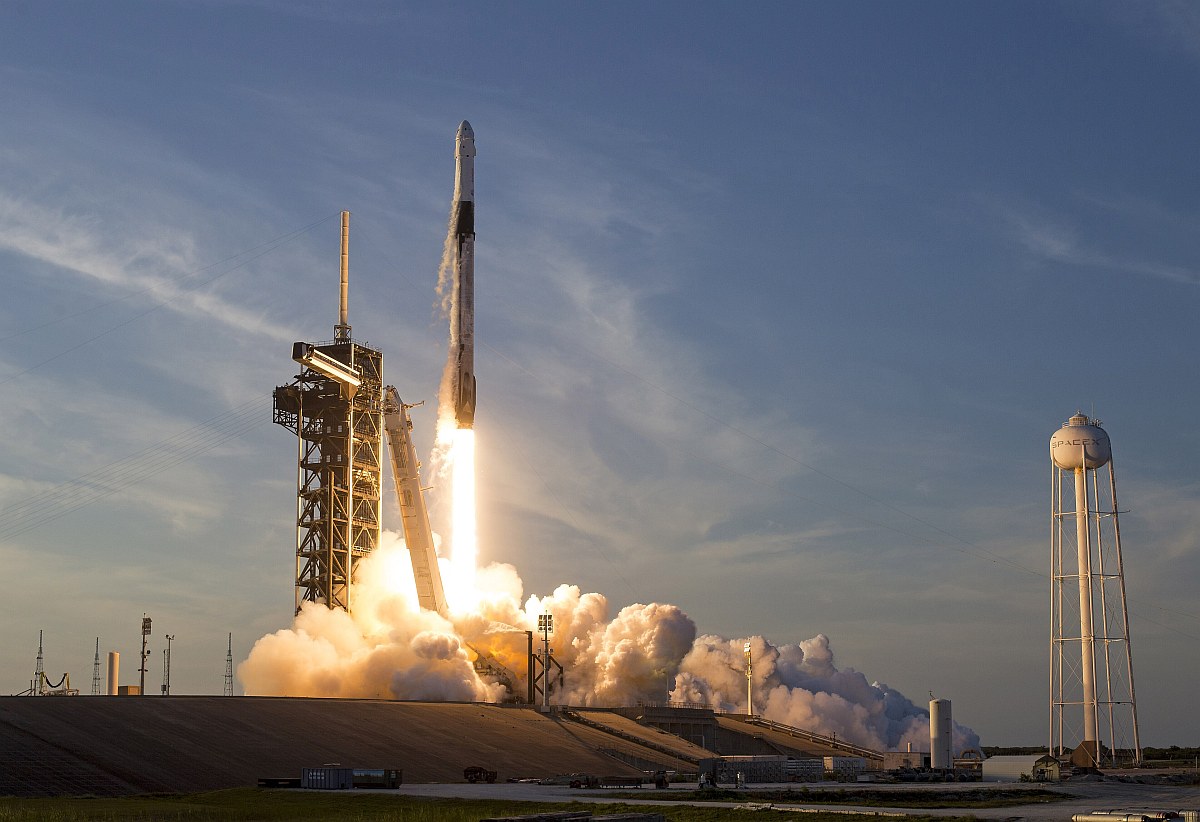
Dragon’s Flight: SpaceX Crew-10 launches aboard a SpaceX Falcon 9 rocket carrying the Dragon spacecraft piloted by astronaut and Air Force Maj. Nichole “Vapor” Ayer at Kennedy Space Center, FL, March 14, 2025. Credit: NASA/Aubrey Gemignani
Falcon 9 sets another launch record
The most immediate SpaceX news came on August 15, 2026, when the company launched two Falcon 9 rockets only about 38.5 minutes apart, establishing a new company record for the shortest interval between two orbital launches. (Spaceflight Now)
The first rocket lifted off from Cape Canaveral Space Force Station in Florida carrying eight satellites for Globalstar. Its first-stage booster, flying for the 14th time, returned to Landing Zone 40 approximately eight minutes after launch.
While that mission was still underway, another Falcon 9 lifted off from Vandenberg Space Force Base in California carrying the classified USSF-366 payload for the U.S. Space Force. Its booster successfully landed on the drone ship Of Course I Still Love You. The recovery represented the 650th successful landing of a Falcon booster. (Spaceflight Now)
The two launches demonstrate what has become one of SpaceX’s greatest competitive advantages: launch operations are increasingly resembling an industrial production system rather than a succession of unique aerospace projects.
Falcon 9 is no longer simply a reusable rocket. It has become the backbone of a high-frequency transportation network between Earth and orbit.
Starship Flight 14 could be far more important
Despite Falcon 9’s continuing success, SpaceX’s long-term strategy increasingly revolves around Starship.
The company’s 13th Starship test flight, conducted on July 24, was an important milestone. Starship released 20 next-generation Starlink V3 satellites on a suborbital trajectory. The satellites briefly communicated with the existing Starlink network before re-entering the atmosphere as planned. The spacecraft itself survived atmospheric re-entry with significantly less apparent heat-shield damage than in previous tests and completed its landing maneuver before splashing down in the Indian Ocean. (Reuters)
The Super Heavy booster performed less successfully. Five engines failed to reignite during its return, resulting in a harder-than-planned impact in the Gulf of Mexico. (Reuters)
Nevertheless, attention has already shifted to Starship Flight 14, tentatively planned for the end of August.
If regulatory approval is obtained, SpaceX intends to attempt something it has never done before: return the Starship upper stage to Starbase and catch it with the mechanical arms of its launch tower. SpaceX has previously caught Super Heavy boosters with tower arms, but catching the orbital spacecraft would represent another major step toward complete rocket reusability. (Reuters)
The mission is also expected to attempt the first orbital deployment of Starlink V3 satellites. SpaceX says the new generation should provide roughly ten times the broadband capacity and data density of its current satellites. Eventually, the company plans to carry as many as 60 V3 satellites on a single Starship mission. (Reuters)
This explains why Starship is much more than an exceptionally large launch vehicle. It is an essential part of the future economics of Starlink.
Starlink is becoming the center of the SpaceX business model
SpaceX already operates the largest satellite constellation ever created, with more than 10,000 Starlink satellites deployed. But the next stage of the network could be dramatically larger and more capable.
Starlink has also become increasingly important financially. Reuters reported that Starlink accounted for roughly 60% of SpaceX’s revenue in 2025, generating about $11.4 billion that year. (Reuters)
SpaceX’s second-quarter 2026 results further illustrated that transformation. Revenue reached approximately $7.8 billion, up 92% from $4.1 billion a year earlier, while the company reported a net loss of $541 million. Starlink remained a major source of growth as SpaceX continued investing heavily in Starship and other projects. (Reuters)
The technological relationship between Starship and Starlink is therefore becoming increasingly important. Falcon 9 can launch approximately two dozen current-generation Starlink spacecraft at a time, while Starship is designed to deploy much larger batches of V3 satellites.
If SpaceX can make Starship rapidly reusable, it could dramatically increase the amount of communications capacity placed in orbit while reducing the effective launch cost per satellite.
Starlink expands into Vietnam
Starlink’s terrestrial expansion is also continuing.
On August 13, the service began accepting orders in Vietnam. Residential service starts at about 1.13 million Vietnamese dong, approximately $43 per month, with customers purchasing the necessary hardware separately. (Reuters)
Vietnam has authorized Starlink on a trial basis through the end of 2030, with the number of subscribers capped at 600,000 during that period. The country has also authorized four Starlink ground gateway stations.
Vietnam becomes the sixth Southeast Asian market with Starlink service, following Indonesia, Malaysia, the Philippines, Singapore and East Timor. (Reuters)
Expansion into markets where conventional broadband infrastructure is incomplete or geographically difficult could become one of Starlink’s strongest long-term advantages.
At the same time, SpaceX is increasingly developing direct-to-device satellite communications. The V3 generation is expected to provide substantially greater capacity for services that allow ordinary mobile phones to connect directly to satellites outside conventional cellular coverage. (Reuters)
SpaceX is becoming still more important to NASA
Starship’s progress is also critical to NASA.
NASA is working with SpaceX on a Starship-based Human Landing System (HLS) for the Artemis lunar program. Recent wind-tunnel testing at NASA’s Ames Research Center has examined the aerodynamic behavior of the Version 3 Super Heavy booster during atmospheric return. NASA says Starship and Super Heavy Version 3 are expected to form the basis of the system used for Artemis demonstrations and ultimately a crewed lunar landing. (NASA)
The relationship now extends beyond rockets and lunar landers.
NASA announced in July that it had selected SpaceX to supply Starlink laser communications technology for Orion during Artemis III. Two Starlink mini laser terminals are to be installed on the exterior of the Orion spacecraft, allowing large amounts of data — including 4K imagery and video — to be transmitted through optical communications links. (NASA)
The development is significant because it demonstrates how technologies originally created for SpaceX’s commercial satellite network are beginning to migrate into major government exploration programs.
SpaceX is therefore becoming involved in Artemis at multiple levels: launch technology, lunar landing systems and communications infrastructure.
A growing national-security role
SpaceX’s relationship with the U.S. government is expanding in another direction as well.
On July 29, the U.S. Space Force awarded SpaceX $1.6 billion for 18 Falcon 9 launches through 2027. The missions will deploy Pentagon satellites associated with detecting and targeting airborne objects. (Reuters)
According to Reuters, SpaceX has received at least $7 billion in Pentagon contracts during 2026, including major satellite-network contracts associated with U.S. missile-warning, communications and targeting capabilities. (Reuters)
The August 15 USSF-366 mission illustrates how routine these national-security launches are becoming within SpaceX’s overall launch schedule.
This success also produces a strategic concern: both NASA and the Pentagon increasingly depend on a company whose launch rate is far ahead of those of its competitors.
SpaceX’s success may be creating a launch-capacity problem
Ironically, one of the latest controversies surrounding SpaceX results from its own success.
A Reuters analysis found that approximately 79% of Falcon 9 missions in 2026 have been devoted to Starlink, compared with 54% in 2020. Several satellite companies have reportedly been told that Falcon 9 launch opportunities are effectively booked until 2028 or 2029. (Reuters)
SpaceX therefore faces an unusual economic decision.
Every Falcon 9 or future Starship flight used for a commercial customer is a flight that cannot simultaneously launch SpaceX’s own Starlink satellites. If the long-term revenue produced by those satellites exceeds the fee SpaceX can charge an outside customer, prioritizing internal payloads makes financial sense.
But that vertical integration could also make access to orbit more difficult for companies that do not own their own launch vehicles.
In other words, SpaceX’s achievement in reducing launch costs has not necessarily solved the broader problem of scarce access to space. It may instead be changing the nature of that scarcity.
The next milestone: making Starship operational
The central question surrounding SpaceX is no longer whether Falcon 9 works. Its extraordinary launch frequency and hundreds of successful booster recoveries have largely settled that question.
The uncertainty lies with Starship.
For years, Starship has been an experimental rocket whose spectacular successes and failures were part of a rapid development program. But the next few missions could mark a transition from experimentation to practical transportation.
Flight 14 is particularly important because it brings together several technologies on which SpaceX’s future depends: orbital Starlink V3 deployment, controlled return of the spacecraft, tower recovery and ultimately rapid reuse.
Elon Musk has said he expects Starship’s launch frequency eventually to increase to at least one flight per day. That remains an extremely ambitious target rather than an established capability. (Reuters)
But even a fraction of such a launch rate would fundamentally change spaceflight.
A fully reusable Starship capable of repeatedly transporting enormous payloads to orbit could accelerate Starlink deployment, support NASA’s lunar architecture, enable large commercial spacecraft and dramatically increase the amount of infrastructure humans can place beyond Earth.
A company moving from rockets to space infrastructure
The latest SpaceX news suggests that the company is undergoing a deeper transformation.
Falcon 9 established SpaceX as the dominant launch provider. Starlink turned it into a global telecommunications operator. Starship is intended to provide an entirely new scale of transportation. Meanwhile, contracts with NASA and the U.S. Space Force are integrating SpaceX technology increasingly deeply into America’s civil and military space infrastructure.
The record-setting launches of August 15 demonstrate how mature one part of this system has become. The upcoming Starship test will show how close the next part is to achieving the same transformation.
For SpaceX, therefore, the most important event of August 2026 may not simply be another rocket launch. It may be evidence that the company is approaching the point where fully reusable heavy-lift spaceflight moves from an experimental goal toward an operational system.
If that transition succeeds, the consequences will extend well beyond SpaceX itself. They could reshape satellite communications, lunar exploration, national-security space operations and the economics of access to orbit for the rest of the industry.
I can also monitor SpaceX and prepare a new summary whenever there is a major Starship launch, NASA announcement, or other significant development.
Discover more from MultiMedia
Subscribe to get the latest posts sent to your email.





Leave a Reply