




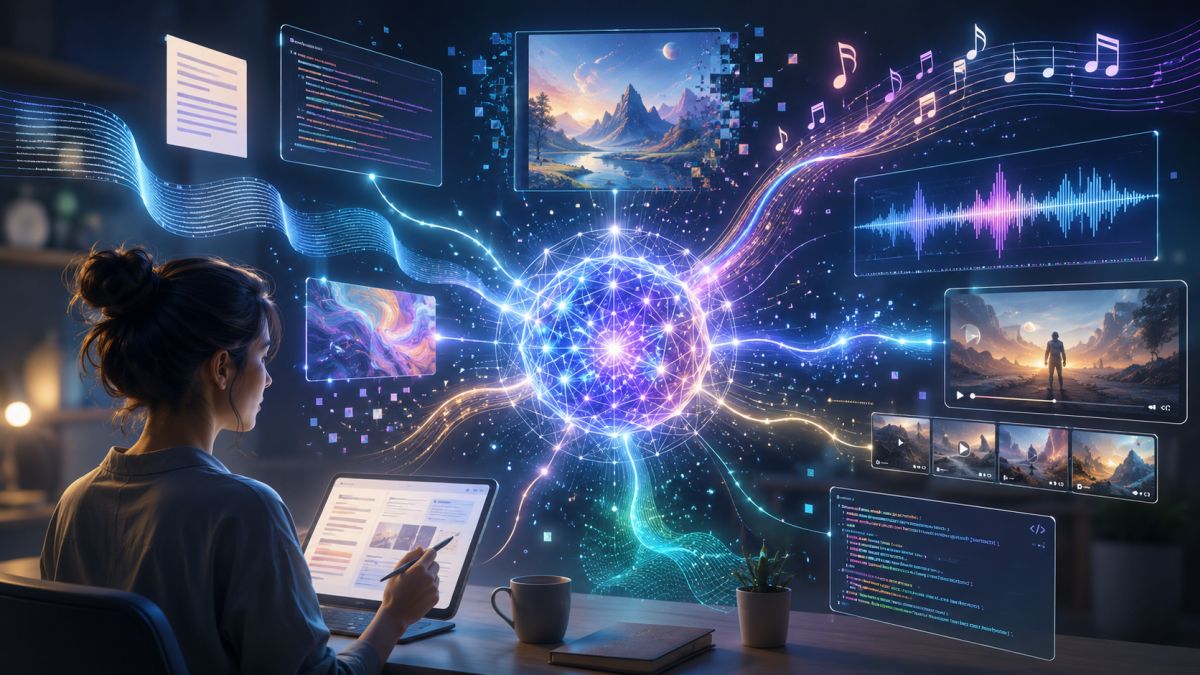
Generative artificial intelligence is a category of artificial intelligence systems capable of creating new content based on patterns and regularities identified in the data on which they were trained. This content can take many different forms: text, images, music, audio recordings, videos, computer programs, three-dimensional models, or even combinations of these.
Unlike traditional computer systems, which mainly execute instructions explicitly defined by programmers, generative systems can produce results that were not previously entered, in that exact form, into their databases.
From Traditional Artificial Intelligence to Generative AI
Artificial intelligence is a much broader field than generative artificial intelligence. Many AI systems are designed for classification, prediction, or decision-making.
For example, a system can analyze a medical image and estimate the probability of a certain condition being present. Another system can detect suspicious banking transactions or recommend products to a customer.
Such systems analyze information and usually provide a classification, a score, or a prediction.
Generative artificial intelligence goes one step further: it produces content.
A generative system may receive the instruction:
“Write an introductory article about quantum mechanics for high school students.”
Based on this request, the system can generate an original text adapted to the specified level.
Similarly, an image generator may receive the description:
“A futuristic city built on Mars, seen at sunset.”
The system will create an image corresponding to that description, even though that exact image did not previously exist.
How Does Generative Artificial Intelligence Work?
At the core of most modern generative AI systems are artificial neural networks with a very large number of parameters.
During the training process, these networks analyze enormous amounts of data and learn the statistical relationships between their elements.
In the case of a language model, the system analyzes relationships between words, expressions, sentences, and contexts. It does not simply memorize all the texts it has analyzed; instead, it builds an extremely complex mathematical representation of how language is used.
When it receives a question or instruction, the model generates its response by successively estimating which element is most appropriate to continue the sequence.
In simplified terms, a language model can be viewed as a highly sophisticated system for predicting the next word or, more precisely, the next “token,” a unit into which text is divided for processing.
By repeating this process many times, the system can produce sentences, articles, or complex conversations.
Large Language Models
One of the best-known forms of generative artificial intelligence is represented by Large Language Models, or LLMs.
These models are trained on very large quantities of text and can perform many different tasks:
- writing and reformulating texts;
- translating between languages;
- summarizing documents;
- explaining concepts;
- generating ideas;
- writing and analyzing computer code;
- answering questions;
- assisting with research and documentation.
Their capabilities do not result from having separate rules for each of these activities. Instead, they emerge from learning general structures of language and information present in the training data.
Image Generation
Generative artificial intelligence is not limited to text.
Image-generation models can transform a textual description into an image. The user can specify the objects, characters, artistic style, lighting, colors, perspective, or desired atmosphere.
Some systems also allow users to modify existing images. Objects can be removed or added, backgrounds can be changed, and photographs can be transformed into artistic representations.
Many modern image-generation systems use so-called diffusion models. In simplified terms, these models learn to reconstruct images from random noise, gradually guiding the process toward the representation requested by the user.
Generating Music, Voice, and Video
Generative technologies can also create audio content.
They can produce original music, synthetic voices, sound effects, spoken content, or vocal performances.
Other models can generate videos from textual descriptions or images.
For example, an instruction such as:
“A spacecraft slowly passes by the planet Saturn”
can be transformed into a short video sequence.
As the technology develops, the boundaries between text, image, audio, and video generation are becoming increasingly blurred.
Multimodal Artificial Intelligence
An important direction in current development is multimodal artificial intelligence.
A multimodal system can work simultaneously with several types of information: text, images, sound, video, or documents.
For example, a user may provide a photograph and ask:
“What objects appear in this image?”
or upload a chart and request an interpretation of it.
Such a system is no longer merely a text generator but becomes a general-purpose tool for interacting with information.
What Is a Prompt?
The instruction given to an artificial intelligence system is often called a “prompt.”
The quality of the prompt can significantly influence the quality of the result.
For example, the request:
“Write about energy”
is very general.
A request such as:
“Write an article of approximately 1,000 words about renewable energy for high school students, explaining solar, wind, and hydroelectric power”
provides the system with much more information about the desired result.
Effective use of generative systems therefore also involves the ability to formulate clear and well-structured instructions.
Generative Artificial Intelligence Does Not Necessarily “Think” Like a Human
The impressive performance of these systems can create the impression that they understand the world in exactly the same way humans do.
The situation, however, is much more complex.
Artificial intelligence models process mathematical representations and identify statistical relationships in data. They can produce coherent explanations, perform complex reasoning, and solve many problems, but these abilities do not automatically demonstrate the existence of consciousness or subjective experience.
The question of whether artificial intelligence could ever become conscious remains one of the major issues at the intersection of computer science, neuroscience, and philosophy.
What Are AI “Hallucinations”?
One important limitation of generative systems is their ability to produce false information in a highly convincing form.
This phenomenon is commonly referred to as a “hallucination.”
For example, a language model may invent a book, a bibliographic reference, a date, or an event that does not exist.
The reason is related to the way the model works. Its fundamental objective is to generate a plausible continuation based on learned patterns, not to automatically guarantee the truth of every statement.
For this reason, important information should be verified through independent sources, especially in fields such as medicine, law, scientific research, or finance.
Where Is Generative Artificial Intelligence Used?
Its applications are rapidly expanding into almost every field.
In education, it can explain lessons, create exercises, and adapt materials to the learner’s level.
In research, it can assist with analyzing academic literature, producing summaries, and exploring hypotheses.
In programming, it can generate code, identify errors, and explain software.
In publishing and editorial work, it can assist with writing, translation, proofreading, and summarization.
In marketing and advertising, it can produce texts, graphic concepts, and promotional materials.
In industry, it can support product design and the simulation of possible solutions.
In entertainment, it can contribute to the development of games, films, music, and visual effects.
The Risks of Generative Artificial Intelligence
The ability to rapidly produce realistic content also brings important risks.
These include misinformation, the generation of fake images and videos, voice imitation, copyright infringement, violations of privacy, and the use of AI systems for fraud.
There is also the problem of errors. A fluently written answer is not necessarily a correct one.
For this reason, the responsible use of artificial intelligence requires maintaining human oversight over important decisions.
Will Artificial Intelligence Replace Humans?
It is probably more accurate to view generative artificial intelligence as a technology that transforms professions rather than as a system that simply eliminates people from the workplace.
Many repetitive activities can be automated. At the same time, new ways of working are emerging in which humans and artificial intelligence collaborate.
A journalist can use an AI system for research and information structuring, but remains responsible for verifying and interpreting that information.
A programmer can automatically generate pieces of code, but must still understand the architecture of the software and verify the result.
A teacher can rapidly create personalized exercises, but the educational relationship, student assessment, and the setting of pedagogical objectives remain deeply human activities.
Artificial Intelligence as an Assistant
One of the most important transformations may be the emergence of personal and professional assistants based on artificial intelligence.
These assistants can help users organize information, analyze documents, draft materials, prepare meetings, or plan activities.
In the long term, such systems could become universal interfaces between people and the digital world.
Instead of separately using dozens of software applications, we might simply formulate a request in ordinary language:
“Analyze these documents, extract the main ideas, and prepare a ten-slide presentation.”
The system could then automatically perform several of the operations required to complete the task.
A Technology with Major Impact
Generative artificial intelligence represents one of the most important technological developments of the early twenty-first century.
Its importance comes not only from its ability to automate certain activities, but also from the fact that it allows people to interact with computer systems using natural language.
For the first time, the computer is no longer merely a machine that must be given instructions in a technical language. It can become a working partner to whom we explain what we want in almost the same way we would explain it to another person.
This change may profoundly influence education, research, the economy, culture, and the way we work with information.
Generative artificial intelligence, however, should be viewed neither as an infallible technology nor as a universal substitute for human intelligence. Its real value depends on how people learn to use it, verify its results, and combine its computational capabilities with human judgment, creativity, and responsibility.
Discover more from MultiMedia
Subscribe to get the latest posts sent to your email.






Leave a Reply