




The terms artificial intelligence, machine learning, and deep learning are often used as if they referred to the same thing. In reality, they describe different concepts that are nevertheless closely related.
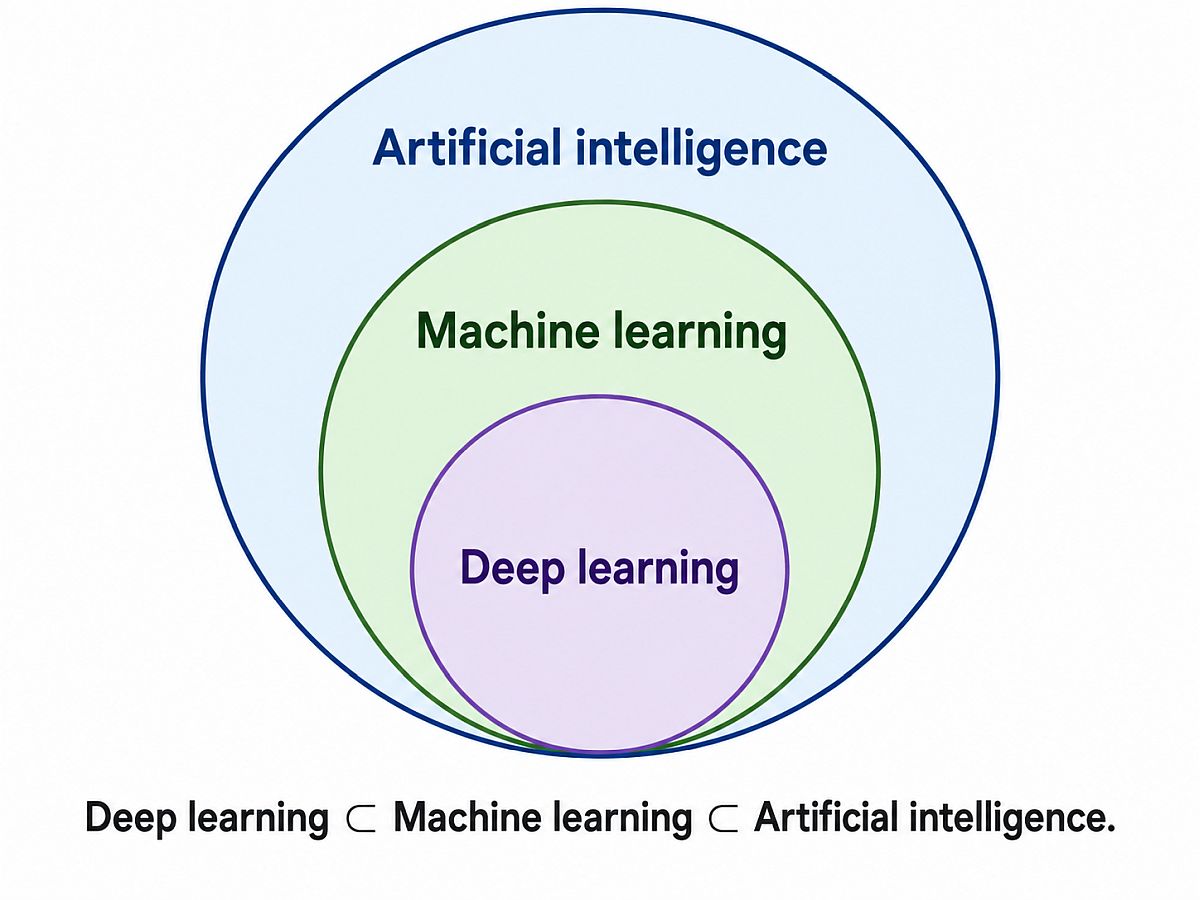
The simplest way to understand this relationship is to imagine three concentric circles. Artificial intelligence (AI) is the largest circle. Inside it is machine learning (ML). Inside machine learning, in turn, is deep learning (DL).
Therefore:
Deep learning ⊂ Machine learning ⊂ Artificial intelligence.
Every deep learning system is a machine learning system and, in a broader sense, an artificial intelligence system. But not every artificial intelligence system uses machine learning, and not every machine learning system uses deep learning.
This distinction is important for understanding both the history of artificial intelligence and the way modern applications work, including ChatGPT, facial recognition systems, autonomous vehicles, and image-generation tools.
What Is Artificial Intelligence?
Artificial intelligence (AI) is the broadest field. Its goal is to develop computer systems capable of performing tasks that, if carried out by humans, would normally require certain forms of intelligence.
These tasks may include:
- understanding and producing language;
- recognizing images and objects;
- solving problems;
- planning;
- making decisions;
- making predictions;
- learning from experience;
- playing strategy games;
- controlling robots and other autonomous systems.
Artificial intelligence is therefore more of a general field and objective than a specific technology.
An artificial intelligence program does not necessarily have to “learn.” Early AI systems operated largely on the basis of rules explicitly entered by programmers.
For example, a system might be given the rule:
“If the temperature exceeds 38 °C and the patient shows certain symptoms, check for the possibility of an infection.”
Such a system can make decisions or formulate recommendations without having learned these rules on its own from data.
This is one reason why artificial intelligence is not synonymous with machine learning.
Rule-Based Artificial Intelligence
An important part of the history of artificial intelligence is represented by rule-based systems, sometimes referred to as symbolic AI.
Programmers or human experts formulated rules such as:
IF condition X occurs, THEN perform action Y.
A simplified example might be a chess program.
Programmers can introduce rules concerning the legal moves of the pieces, position evaluation, protection of the king, or material advantage.
The program does not have to discover these rules by itself.
During the 1970s and 1980s, expert systems also became popular. These were designed to reproduce, within a limited domain, the decision-making process of a human specialist.
A medical expert system, for example, could use hundreds or thousands of rules developed together with physicians.
The problem with this approach is that the real world is extremely complex. For many problems, it is almost impossible to formulate all the necessary rules manually.
How could a programmer write precise rules for recognizing every possible cat in photographs?
A cat may be white, black, or multicolored, viewed from the front or from the side, partially hidden, indoors or outdoors. The number of possible variations is enormous.
In such situations, it became much more efficient for the system to learn the rules from examples.
This is where machine learning comes in.
What Is Machine Learning?
Machine learning (ML) is a branch of artificial intelligence in which computer systems learn patterns and regularities from data instead of having every rule explicitly programmed.
The fundamental idea is relatively simple.
Instead of telling the computer in detail:
“These are all the rules by which you can recognize a cat,”
we provide it with a large number of examples of images containing cats and images without cats.
A machine learning algorithm analyzes these examples and tries to discover the statistical characteristics that distinguish the two categories.
After training, the system can be shown an image it has never seen before and asked to estimate whether or not it contains a cat.
Machine learning therefore represents a shift from:
“The programmer defines all the rules”
to:
“The algorithm discovers certain rules or patterns from data.”
This is one of the most important changes in the history of modern computing.
How Does a Machine Learning System Learn?
In a traditional computer system, we have, in simplified form:
data + rules → result.
In machine learning, the training process can be viewed as:
data + known results → model.
The resulting model can then be applied to new data:
new data + model → prediction.
Suppose we want to estimate the price of a home.
We can provide the algorithm with data about thousands of previously sold homes:
- area;
- number of rooms;
- year of construction;
- neighborhood;
- floor;
- presence of a garage;
- distance from the city center;
- sale price.
The algorithm analyzes the relationships between these characteristics and the prices.
After training, we can enter the characteristics of a new home, and the system will estimate its likely price.
The model does not “understand” real estate in the same way a real estate agent does. It identifies statistical relationships in the data and uses them to produce a prediction.
Main Types of Machine Learning
Machine learning includes many techniques, but three categories are particularly important.
Supervised learning uses examples for which the correct result is already known.
For example, a system can be shown thousands of messages labeled “spam” or “not spam.” The algorithm learns the characteristics associated with each category and can subsequently classify new messages.
Unsupervised learning uses data that have not been labeled in advance. The algorithm attempts to discover structures, groups, or regularities on its own.
For example, an online store can analyze customer behavior and automatically group customers into categories with similar patterns of behavior.
Reinforcement learning involves a system learning through interaction with an environment. Good actions are rewarded, while unfavorable ones are penalized.
This method can be used in robotics, games, or the optimization of complex processes.
Machine learning, however, does not automatically mean deep learning. There are many machine learning algorithms that do not use deep neural networks.
What Is Deep Learning?
Deep learning is a special category of machine learning based mainly on artificial neural networks with multiple layers.
The word “deep” refers precisely to the presence of several levels or layers through which information is processed.
Artificial neural networks were inspired, in a highly simplified way, by the organization of biological neurons. This analogy should not be taken too far, however: an artificial neuron is essentially a mathematical structure, and modern neural networks do not faithfully reproduce the functioning of the human brain.
A neural network may contain:
- an input layer;
- numerous intermediate layers, also called hidden layers;
- an output layer.
Each layer transforms the information it receives and passes it on.
During training, millions or even billions of numerical values called parameters are adjusted so that the results produced by the network become increasingly close to the desired results.
Why Has Deep Learning Become So Important?
Neural networks have been studied for many decades, but the spectacular development of deep learning was made possible by a combination of several factors.
First, there are now enormous quantities of digital data: texts, images, audio recordings, videos, and many other types of information.
Second, computing power has increased dramatically. Graphics processing units and other specialized systems allow very large numbers of mathematical operations to be performed quickly.
Third, mathematical methods and neural network architectures have improved considerably.
Deep learning has proved particularly effective in areas where information is highly complex, such as:
- image recognition;
- speech recognition;
- machine translation;
- natural language processing;
- image generation;
- video analysis;
- autonomous driving;
- large language models.
Technologies such as ChatGPT are based on deep learning.
An Example: Recognizing a Cat
The difference between the three concepts can be illustrated using the same problem: building a system that recognizes cats in photographs.
In a classical rule-based artificial intelligence approach, a programmer might try to define certain characteristics: the shape of the ears, the presence of whiskers, the shape of the eyes, and other features.
The problem is that the variations among images are too numerous to be described efficiently through manual rules.
In a machine learning approach, we can extract certain image characteristics and allow an algorithm to learn which combinations are likely to indicate the presence of a cat.
In a deep learning approach, the neural network can also learn the relevant characteristics by itself.
In the first layers, it may identify simple elements such as edges and contrasts. The following layers may combine this information to detect shapes, textures, or parts of objects. Deeper layers may eventually represent complex structures associated with a cat.
This ability to automatically construct increasingly complex representations is one of the main advantages of deep learning.
The Essential Differences
The three concepts can be summarized as follows:
| Concept | What It Represents | How It Mainly Works | Example |
| Artificial intelligence | The general field of systems that perform tasks associated with intelligence | Rules, algorithms, machine learning, deep learning, and other methods | Expert system, chess program, AI assistant |
| Machine learning | A subfield of AI | Learns patterns from data | Spam filter, price estimation, recommendation systems |
| Deep learning | A subfield of machine learning | Uses neural networks with many layers | ChatGPT, facial recognition, image generation |
Thus, the difference is not that these technologies compete with one another. They represent different levels within the same field.
We can also express the relationship in this way:
Artificial intelligence is the general objective.
Machine learning is one of the main ways of achieving artificial intelligence.
Deep learning is one of the most powerful current machine learning methods for certain types of problems.
Why Do We Not Always Use Deep Learning?
The spectacular success of deep learning can create the impression that every problem should be solved with very large neural networks. In reality, this is not always necessary or efficient.
Deep learning may require:
- large amounts of data;
- substantial computing power;
- considerable training time;
- high energy consumption;
- specialized hardware.
For some problems, however, a traditional machine learning algorithm can produce very good results while using far fewer resources.
Sometimes even machine learning is unnecessary.
If the rules of a problem are clear and stable, a traditional rule-based program may be simpler, cheaper, and easier to verify.
For example, a system that calculates a tax according to an explicit legal formula does not need to “learn” the formula from thousands of tax returns. It is safer for the formula to be programmed directly.
The choice of technology therefore depends on the problem that needs to be solved.
Where Does Generative Artificial Intelligence Fit In?
Generative artificial intelligence refers to AI systems capable of producing new content, such as text, images, music, voice, video, or computer programs.
Most modern generative systems are based on deep learning.
Large language models, such as those used for ChatGPT, are built with the help of a neural network architecture known as the Transformer.
They are trained on very large amounts of text in order to learn patterns in language. When generating a response, the model successively estimates which elements are appropriate for continuing the text, taking the existing context into account.
Similarly, image-generation systems learn statistical relationships between concepts, descriptions, and visual structures.
We can therefore extend the relationship between the concepts as follows:
Artificial intelligence → Machine learning → Deep learning → many modern generative AI systems.
However, generative artificial intelligence should not be confused with artificial intelligence as a whole. It represents only one of its many applications.
Do These Systems Learn Like Humans?
The word “learning” can sometimes cause confusion.
When we say that a machine learning algorithm “learns,” this does not necessarily mean that the process is equivalent to human learning.
A child can understand a concept after very few examples and integrate it with their general experience of the world. Machine learning systems often require very large quantities of data and primarily identify mathematical and statistical relationships.
Likewise, the fact that a model has learned to produce a correct answer does not automatically mean that it “understands” the problem in the human sense.
This difference is particularly important in the case of generative systems. A language model can produce highly convincing explanations and still sometimes generate false information.
The performance of an AI system should not automatically be confused with human intelligence, understanding, or consciousness.
Which of the Three Technologies Is the Most Important?
The question does not have a single answer because the three concepts exist at different levels.
Artificial intelligence is the general field.
Machine learning has become one of the most important methods for building modern AI systems.
Deep learning is the technology that has enabled many of the most spectacular recent advances, particularly in the processing of language, images, audio, and video.
However, each method has its place.
A simple rule-based system may be the ideal solution for a particular problem. For another problem, a traditional machine learning algorithm may be sufficient. For highly complex tasks, such as understanding and generating natural language, deep learning may be the appropriate choice.
Therefore, the most sophisticated technology is not always the best one. What matters is that the method used is appropriate for the problem that needs to be solved.
Conclusion
Artificial intelligence, machine learning, and deep learning are not synonymous. They represent different levels within a very broad technological field.
Artificial intelligence is the general concept and includes any method by which computers can perform tasks traditionally associated with intelligence.
Machine learning is a branch of artificial intelligence in which systems learn patterns and regularities from data instead of receiving every rule explicitly from programmers.
Deep learning is, in turn, a branch of machine learning based on neural networks with many layers and is the technology underlying many modern AI systems.
The relationship can be remembered very simply:
Artificial intelligence → Machine learning → Deep learning.
ChatGPT, modern image-recognition systems, and many generative artificial intelligence applications are located toward the end of this sequence: they are artificial intelligence applications built using machine learning and, more specifically, deep learning.
Understanding this hierarchy provides an important foundation for understanding many other concepts in artificial intelligence, from neural networks and language models to generative AI and autonomous systems.
Discover more from MultiMedia
Subscribe to get the latest posts sent to your email.






Leave a Reply