




Definitions
Scalar field: application which associates a scalar (i.e. a number) with each point in space.
Vector field: application which associates a vector with each point in space.
Edges of volumes and surfaces: for a volume V, we note ∂V the surface delimiting this volume, oriented outwards (we also call it edge of V). Likewise, for an oriented (not closed) surface S, we note ∂S the contour “going around” this surface; its orientation depends on that of the surface (it is the edge of S). An example is given in Fig. 1.
Usual field characteristics
Level surface: for a scalar field f, set of points M such that there exists a constant k verifying f(M) ⸦ {k}
Field line: for a vector field , line L such that ∀M ∈ L, (M) is collinear with (M) or (M) is the tangent vector to L in M.
Fundamental quantities associated with a vector field
Circulation of a vector field: on an oriented contour C, C = ∫C·d. More precisely, a contour is an application : [0,1] → R3 and C = ∫01((s)) (s)ds
Flow of a vector field: through an oriented surface S: Φ= ∫C·d. A more precise definition involves a parameterization of the surface.
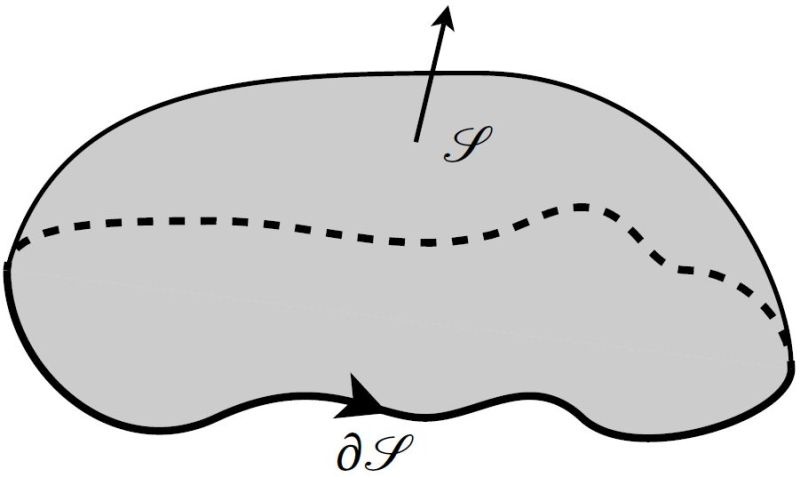
Fig. 1.1 – Oriented surface and its edge.
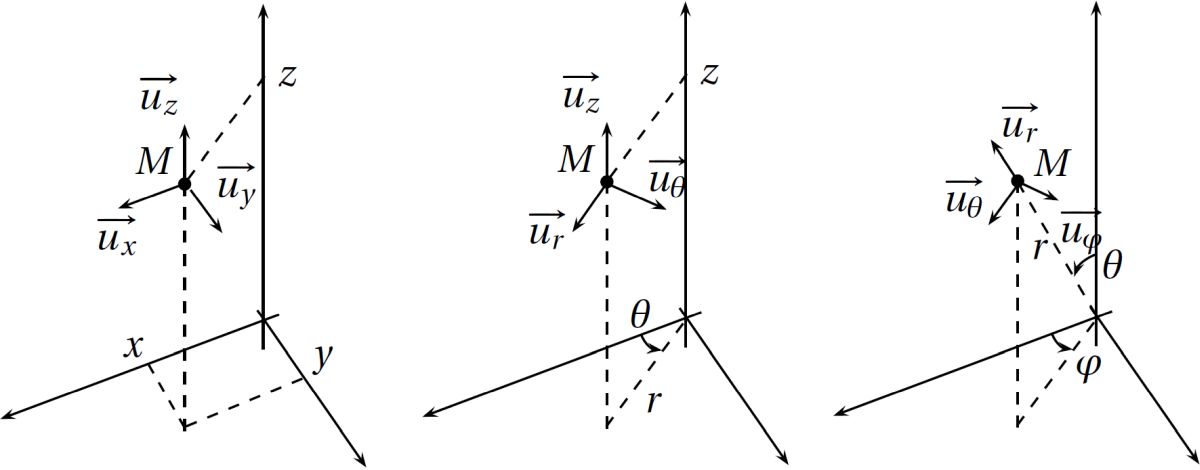
Fig. 1.2 – Cartesian, cylindrical and polar coordinates.
Locating a point in space
Cartesian coordinates: a point M is identified by its coordinates (x,y,z) such that = xx
+ yy + zz
Cylindrical coordinates: a point M is identified by its coordinates (r,θ,z) such that = rr + zz
Spherical coordinates: a point M is identified by its coordinates (r,θ,φ) such that = rr
Source: Vincent Démery, Physique – 1ère année – 2ème année PSI. License CC BY-SA 2.0 FR. Translation and adaptation by Nicolae Sfetcu

Translation Style Guide for European Union Member States
Professional. Practical. Precise. Make your translations resonate across borders.
Last Thoughts
Discover the Wisdom of a Universal Genius in “Last Thoughts” by Henri Poincaré

Physics Help
Covering everything from classical mechanics to quantum field theory, designed to make complex topics accessible.
Discover more from MultiMedia
Subscribe to get the latest posts sent to your email.


Leave a Reply