




The same trait is found in his theology. Where ancient Stoicism identified, Posidonius seems to have sought to distinguish: according to Aetius[1], he separated Zeus, nature, and destiny as three terms, each subordinate to the preceding one; Zeus would be force in its unity, destiny the same force considered in its multiple aspects, while nature could be seen as the power emanating from Zeus, to connect the multiple forces of destiny. This triad or trinity is found in Cicero concerning the origin of divination in his treatise On Divination, entirely inspired by the five books that Posidonius wrote on the same subject. Divination can come either from God, when God prophesies through the mouth of an inspired prophetess, or from destiny in the case of astrology, whose rules are based on observation, or from nature when, for example, in sleep, the soul, freed from the body, has prophetic dreams. The soul thus has direct relations with God through mystical enthusiasm, while destiny is governed by laws that are merely objects of observation, and nature contains the principle of all events.
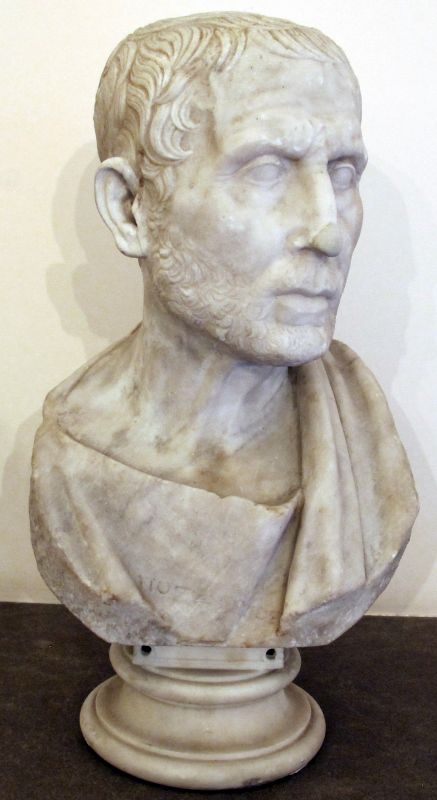
Posidonius, ancient Roman busts in the Museo Archeologico (Naples)
Finally, we find the same tendency in his psychology; contrary to Chrysippus’s opinion, he believes it impossible to explain passion without admitting in the soul the distinction and hierarchy of faculties discovered by Plato. We have, through Galen, the details of his critique of Chrysippus. Where, he asks first, would the unreasonable exaggeration of the tendency that constitutes passion come from if there were only reason in man? Pleasure, it is said, is merely the perception of a good; but then the wise, knowing their happiness, should experience pleasure. It is true that, according to Zeno, it is the recent perception of a good; if it thus depends on duration, it is because it has a cause other than the purely intellectual fact of opinion. Chrysippus can tell us nothing about the cause of passion; he attributes it to a sickness of the soul, but without discovering the cause of this sickness; he says that one must experience it with an uncommon weakness, which is false, since there are as many degrees of passion as there are degrees of advancement toward wisdom. Finally, passion should be the same when the opinion on good and evil is the same; but this is not the case, and habit or vice causes stronger passions for the same opinion. The true cause of passions is that there are two parts within us: a daemon that is of the same nature as God, and an evil, bestial, unreasoning, atheistic part. Passion consists in bending the first part to the second; contrary to what Chrysippus says, there are inclinations that are inherently bad; our very physical temperament predisposes us to certain passions; and it is not through arguments that one softens or combats passions; one can only act upon the irrational through irrational means; for example, certain musical rhythms relax anger or desire.
Throughout, Posidonius seems to have aimed to discover the dynamic connections between things. “The good geographer,” he says, “must consider earthly things in relation to the celestial.” On this principle, he seeks causes in the manner of Aristotle, without concerning himself with the supposed mystery of things. Overall, he tries to deduce, from the location of zones determined by mathematical astronomy, the climatic conditions and their influence on the organism. Thus, despite purely physical geography, which dismisses the fact as mere folklore, he accepts the account of Pytheas of Marseille, who had observed a country where the shortest winter day lasted four hours, and the longest summer day eighteen hours. The same spirit, both experimental and mathematical, is evident in his theory of tides; he observes their daily, monthly, and annual variations, and, following a few others, attributes them to the influence of the moon, to which he adds the action of the sun.
Posidonius’s taste for the sciences naturally extends to the arts, which constitute civilization and which he considers the fruit of humanity’s highest wisdom. ‘How,’ Seneca asks him, criticizing his ideas on this point, ‘can one admire both Diogenes and Daedalus?’[2] This question reveals how far Posidonius’s philosophy, which claims to encompass humanity and nature in all their most complex manifestations at a single glance, surpasses the meager asceticism of the Cynics. He traces the role of wisdom throughout the entire history of humanity; past golden age, when the wise were kings, they had to become legislators and invent laws to counter the growing vices of humankind; then they invented the arts that facilitate daily life, such as building; they discovered metals, and their uses, the agricultural arts, the flour mill; Anacharsis invents the potter’s wheel; Democritus the pottery kiln. Seneca is somewhat scandalized by the mundane nature of this wisdom. For Posidonius, it is evident that nothing is inseparable and that human reason must be equally artisan and theoretical. These great discoveries are, moreover, made through borrowings from nature: the fire of a forest first melted metals; human teeth began to grind wheat grain; there is not, between art and nature, the opposition that people like to point out.
Posidonius applies the same idea to the history of civilization; in his continuation of Polybius, in fifty-two books that deal with the events that took place from 145 to 86, he assesses Roman civilization as a continuation of the preceding Etruscan and Greek civilizations; But it gave them perfection and completion.
History, like geography, like morality and physics, testifies, for Posidonius, to the same dynamic continuity, which the object of philosophy is to rediscover everywhere.
Notes
[1] Placita, p. 324, 4 (Diels, Doxographi graecij.
[2] Lettre à Lucilius, 90.
Source: Émile Bréhier(1951). Histoire de la philosophie, Presses Universitaires de France. Translation and adaptation by © 2026 Nicolae Sfetcu

Heavy Water: A School of Romanian Scientific and Technological Research, a Paradigm in Kuhn’s Sense
A powerful insider’s chronicle of Romania’s most ambitious scientific and technological project: the development of heavy water production for nuclear energy.

The Adventures of Pinocchio – A story for adults
Unveiling a Timeless Masterpiece for Modern Times
Philosophy – Basic Notions, Volume 2
Covers ethics, politics, culture, mind, science, and art through diverse philosophical lenses.
Discover more from MultiMedia
Subscribe to get the latest posts sent to your email.


Leave a Reply