




Highly sought after by online stores, service companies, clinics, publishing houses, schools, NGOs. It can answer questions, take orders, search documentation, and send requests to a human operator. McKinsey places “customer operations” among the most important value areas for generative AI.
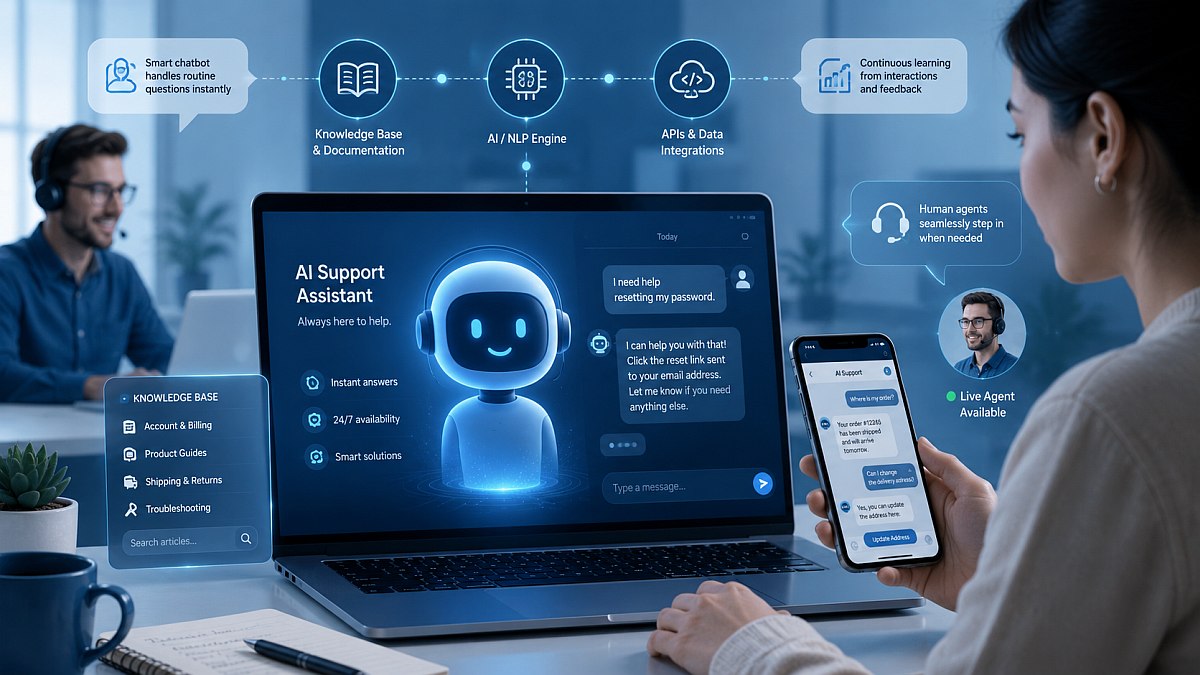
Artificial intelligence is rapidly changing the way companies communicate with customers. In the past, automated support was mainly associated with rigid menus, predefined answers, and forms. Today, a chatbot or AI agent can understand freely formulated questions, consult an organization’s documentation, verify information in databases, and perform certain operations on behalf of the user.
However, developing such a system involves much more than simply connecting a language model to a chat window. An effective AI customer support agent must be designed as a complete system that combines artificial intelligence, the company’s knowledge base, internal applications, security mechanisms, and procedures for escalation to human operators.
1. Chatbot or AI Agent?
A traditional chatbot is designed primarily for conversation. It receives a question and generates or selects an answer.
An AI agent can do more. In addition to conversation, it can use tools and perform actions.
For example, a chatbot may answer:
“You can return the order within 30 days.”
An AI agent could continue:
“I found your order. The product is still within the return period. Would you like me to initiate the return process?”
If the user confirms, the agent can send the request to the order management system and generate the return instructions.
Therefore, the essential difference is between a system that provides information and one that can, within certain limits, take action.
2. Defining the Objectives
The first step in developing an AI agent is clearly defining the problems it should solve.
An online store may want to automate questions related to:
- order status;
- delivery;
- returns;
- product features;
- payment methods;
- warranties.
A software company may have different priorities:
- account configuration;
- password reset;
- common technical problems;
- explanations of application features;
- billing and subscriptions.
It is generally advisable for the first version to handle a limited number of situations, but to handle them very well.
3. Choosing the AI Model
The engine of a modern AI agent is usually a Large Language Model, commonly abbreviated as LLM.
The model should be able to:
- understand natural language;
- maintain the context of a conversation;
- follow instructions;
- use external information;
- generate coherent and relevant answers;
- call software tools or functions when necessary.
However, the model should not be treated as the company’s database.
Information about prices, products, contracts, policies, or orders should come from sources controlled by the organization.
4. Building the Knowledge Base
An AI customer support agent is useful only if it has access to accurate information.
The knowledge base may include:
- FAQ pages;
- manuals;
- technical documentation;
- return policies;
- contractual terms;
- product descriptions;
- internal procedures;
- support articles;
- previously resolved conversations and tickets.
These documents should be cleaned, organized, and updated regularly.
One of the fundamental principles is that the agent should use the company’s information rather than rely exclusively on information learned during the AI model’s training.
5. Using RAG
A widely used architecture is Retrieval-Augmented Generation, abbreviated as RAG.
The process can be simplified as follows:
Customer question → knowledge base search → selection of relevant information → information sent to the AI model → response generation
Suppose a customer asks:
“How long do I have to return a product?”
The system searches the company’s documents and finds the current return policy. The relevant passage is sent to the model, which then generates an answer based on that information.
This method significantly reduces the risk of the AI inventing information.
6. Semantic Search and Vector Databases
In RAG systems, documents are frequently transformed into mathematical representations called embeddings.
Embeddings make it possible to identify semantic similarity between the customer’s question and information contained in documents.
For example, the questions:
“How can I get my money back?”
and
“What is the refund procedure?”
can be recognized as being very similar in meaning even though they use different words.
Embeddings are usually stored in a vector database, which allows relevant information to be retrieved quickly.
7. Designing the Agent’s Instructions
The AI model must receive clear rules regarding its behavior.
A simplified set of instructions might say:
“You are the virtual support agent of Company X. Respond politely and concisely. Use only information provided by the knowledge base. Do not invent prices, deadlines, or policies. If the information is unavailable, say so and transfer the conversation to a human operator.”
These instructions are extremely important.
The agent must know not only what it should do, but also what it is not allowed to do.
8. Connecting the Agent to Company Applications
An AI agent becomes much more useful when it can access external systems.
For example, it may be connected to:
- CRM systems;
- e-commerce platforms;
- billing systems;
- ticketing applications;
- customer databases;
- logistics systems;
- appointment scheduling applications.
The agent can use APIs to perform controlled operations.
It could, for example, have access to functions such as:
check_order()
check_invoice()
create_ticket()
initiate_return()
change_appointment()
The model decides when a function needs to be used, while the application executes the operation.
9. Customer Identification and Authentication
One of the most important issues arises when the agent needs to access personal information.
An agent should not provide information about orders, invoices, or accounts before the user has been properly identified.
Authentication may be performed through:
- the user’s account;
- a code sent by email;
- an SMS code;
- an existing website login;
- SSO systems.
The agent should have access only to the information required to resolve the specific request.
10. Conversation Memory
An AI agent should maintain the context of the conversation.
If a customer says:
“I ordered a laptop last week.”
and later asks:
“When will it arrive?”
the system should understand that the question refers to the laptop mentioned earlier.
Memory can exist at several levels.
Conversation memory stores information during the current session.
Persistent memory, when permitted and justified, may retain certain preferences or relevant information between conversations.
However, persistent memory must be designed carefully from the standpoint of privacy and data protection.
11. Escalation to a Human Operator
A good AI agent must know when to stop.
Not every problem should be automated.
Transfer to a human operator may become necessary when:
- the agent cannot find the answer;
- the customer explicitly requests a human operator;
- the situation is unusual;
- the issue involves a serious complaint;
- a commercial decision is required;
- there are significant legal or financial implications.
The human operator should receive the conversation history and, ideally, an automatically generated summary of the situation.
This way, the customer does not need to explain the entire problem again.
12. Reducing Hallucinations
AI models can sometimes generate information that sounds plausible but is incorrect. This phenomenon is commonly known as hallucination.
In customer support, this can become a serious problem.
For example, the agent might invent:
- a delivery deadline;
- a discount;
- a return policy;
- a product feature;
- a contractual condition.
The risk can be reduced through RAG, strict instructions, and verification of information in company systems.
An important principle is:
When the agent does not know, it must be able to say that it does not know.
13. Implementing Action Limits
The more permissions an agent is given, the more safety measures are required.
Some operations can be performed automatically:
- checking an order;
- providing a document;
- creating a ticket.
Other operations should require customer confirmation:
- canceling an order;
- changing a reservation;
- initiating a return.
Operations with significant financial or legal impact may also require approval from a company employee.
This makes it possible to create a hierarchy of agent autonomy.
14. The User Interface
The agent may be available through several channels:
- a chat window on the website;
- a mobile application;
- WhatsApp;
- Messenger;
- email;
- social platforms;
- telephone, through integration with speech recognition and speech synthesis.
Regardless of the channel, the interface should clearly communicate that the user is interacting with an automated system.
Access to a human operator should also be easy to find.
15. Testing the Agent
Before launch, hundreds or even thousands of test scenarios should be created.
These may include ordinary questions such as:
“What is the delivery time?”
but also ambiguous formulations such as:
“Where is my package?”
or more complicated requests:
“I received a different product from the one I ordered and I want to exchange it.”
The system should also be tested in situations where the user provides incomplete or contradictory information, or tries to persuade the agent to ignore its established rules.
16. Performance Indicators
After launch, the agent’s performance must be monitored continuously.
Important indicators include:
Automated resolution rate – the percentage of requests resolved without human intervention.
Escalation rate – the percentage of conversations transferred to human operators.
Resolution time – the average time required to solve a customer’s problem.
Response accuracy – the proportion of answers that are correct and consistent with official information.
Customer satisfaction – the user’s evaluation of the experience after the conversation.
The most important objective is not simply reducing the number of human operators, but resolving customer problems more quickly and accurately.
17. A Simplified Architecture
A modern system may have the following structure:
Customer
↓
Chat Interface
↓
AI Agent / LLM
↓
Orchestration System
↙︎ ↓ ↘︎
Knowledge Base – CRM – Online Store – Ticketing – Billing
↓
Response or Action
↓
Customer
If the problem cannot be resolved:
AI Agent → Human Operator
This architecture makes it possible to clearly separate the conversational layer from data and operations performed in company systems.
18. From Chatbot to Multi-Agent System
For complex applications, several specialized AI agents may be used.
A system could include:
- an agent for identifying customer intent;
- a product agent;
- a billing agent;
- a technical support agent;
- a returns agent;
- an answer verification agent.
A coordinating agent decides which specialized agent should receive the request.
For example:
Customer → Coordinator Agent → Billing Agent → Accounting System → Coordinator Agent → Customer
This architecture may be useful for large organizations, but it is not always necessary. For many companies, a single well-designed agent connected to several tools is simpler and easier to manage.
19. Developing a First Version
A realistic project can begin with a Minimum Viable Product, or MVP.
The first version might have only three capabilities:
- answering frequently asked questions;
- searching the company’s documentation;
- transferring the conversation to a human operator.
Additional capabilities can then be introduced gradually:
- order tracking;
- ticket generation;
- return processing;
- appointment scheduling;
- CRM integration;
- personalized responses;
- voice support.
This gradual development makes it possible to evaluate performance and reduce risks before increasing the agent’s autonomy.
20. Conclusion
Building an AI chatbot or agent for customer support is more of a software integration project than the simple use of an artificial intelligence model.
The language model represents only the conversational engine.
The real value emerges when it is connected to the company’s information and business processes.
An effective system combines:
AI model + knowledge base + RAG + APIs + internal systems + security rules + human operators
The future of customer support will most likely be hybrid. AI agents will instantly handle many repetitive requests and perform numerous administrative operations, while human employees will focus on complex situations, exceptions, negotiations, and customer relationships.
In this model, artificial intelligence does not simply replace the customer support department. Instead, it becomes the first layer of a system in which automation and human expertise work together.
Discover more from MultiMedia
Subscribe to get the latest posts sent to your email.



Leave a Reply