




Climate tipping points are critical thresholds in the Earth’s climate system that, when crossed, may lead to abrupt and irreversible changes with potentially catastrophic consequences. The epistemological aspect of climate tipping points is a vital and complex topic, given the high stakes involved in understanding, predicting, and mitigating these phenomena. This essay explores the epistemology of climate tipping points, focusing on the challenges and complexities of knowledge production, uncertainty, and decision-making in the context of climate science.
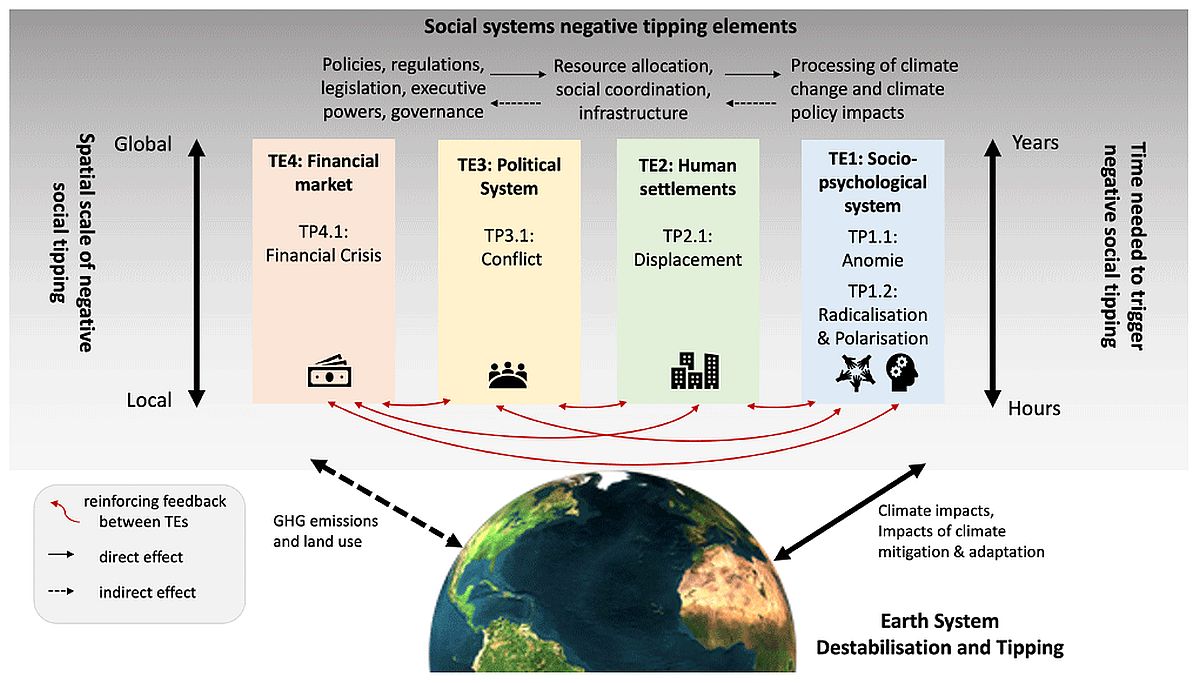
Image source: Viktoria Spaiser, Sirkku Juhola, Sara M. Constantino, Weisi Guo, Tabitha Watson, Jana Sillmann, Alessandro Craparo, Ashleigh Basel, John T. Bruun, Krishna Krishnamurthy, Jürgen Scheffran, Patricia Pinho, Uche T. Okpara, Jonathan F. Donges, Avit Bhowmik, Taha Yasseri, Ricardo Safra de Campos, Graeme S. Cumming, Hugues Chenet, Florian Krampe, and Jesse F. Abrams (2023) Negative Social Tipping Dynamics Resulting from and Reinforcing Earth System Destabilisation, https://doi.org/10.5194/egusphere-2023-1475. Licența CC BY 4.0
Introduction
The concept of climate tipping points has garnered significant attention in climate science and policy discussions in recent years. These are points at which small changes in external conditions can lead to abrupt and potentially irreversible changes in the state of the climate system. Examples include the collapse of the West Antarctic Ice Sheet, the shutdown of the Atlantic Meridional Overturning Circulation (AMOC), and the release of large amounts of methane from thawing permafrost. Understanding and predicting these tipping points is essential for climate mitigation and adaptation efforts. However, the epistemological challenges associated with climate tipping points are substantial, including issues of uncertainty, complexity, and the interface between science and decision-making.
The Nature of Climate Tipping Points
Climate tipping points are characterized by their abrupt and nonlinear nature. Understanding these phenomena requires a multi-disciplinary approach that combines physics, biology, and earth sciences. Researchers must grapple with the intricate interactions between various components of the Earth’s climate system, making it challenging to determine where these tipping points lie and what their consequences might be.
Epistemic Uncertainty
Uncertainty is inherent in the study of climate tipping points. Researchers often deal with multiple sources of uncertainty, including data gaps, model limitations, and incomplete knowledge of underlying processes. The challenge is not only to quantify this uncertainty but also to communicate it effectively to policymakers and the public. Moreover, researchers must contend with the limitations of traditional scientific methods in dealing with complex, nonlinear systems.
Models and Simulations
Climate models and simulations are crucial tools for understanding tipping points. However, these models are approximations of reality and come with their own set of uncertainties. Model development involves simplifications, parameterizations, and choices that can influence the results. The selection of model parameters, boundary conditions, and initial conditions can significantly affect the identification and assessment of climate tipping points.
Ethical and Policy Implications
The epistemological challenges associated with climate tipping points have profound ethical and policy implications. The precautionary principle suggests that in the face of uncertainty, we should take preventive action to avoid potential catastrophic outcomes. But this principle can be in tension with the need for scientific rigor and robust evidence, as policymakers grapple with decisions about mitigating climate change.
Interdisciplinary Collaboration
Given the complexity of climate tipping points, interdisciplinary collaboration is essential. Researchers, policymakers, and stakeholders must work together to integrate knowledge from various fields and develop holistic strategies to address these challenges.
Conclusion
The epistemology of climate tipping points is a critical area of research and inquiry. The multifaceted challenges related to uncertainty, complex modeling, and ethical decision-making require concerted efforts from scientists, policymakers, and the public. By acknowledging and addressing the epistemological complexities of climate tipping points, we can better understand and respond to the urgent climate crisis and the potential catastrophic consequences of crossing these thresholds. The continued pursuit of knowledge in this area is essential for informed climate action.

Climate Change – Global Warming
The history, science, and socio-economic implications of global warming.
Discover more from MultiMedia
Subscribe to get the latest posts sent to your email.


Leave a Reply