




Bernard of Chartres, who taught at Chartres from 1114 to 1124, seems to have had a very clear idea, very characteristic of the Chartres milieu, that the goal of knowledge is not to fix knowledge of the past, but to extend it. “We are like dwarves on the shoulders of giants; we can see more and further than the ancients, not thanks to the acuity of our sight or the size of our body, but because we are supported and raised on them as on giants.”[1] John of Salisbury calls him “the most perfect Platonist of our time”[2]; he is said to have maintained that universals are identical to Platonic ideas; is it Bernard who is also retained in the short exposition of Platonism that follows? John emphasizes the opposition between the immutability of ideas and the mutability of sensible things, drawing inspiration from Seneca (Ep. 59, 19 and 22) whom he formally cites and from Timaeus (49). In any case, one thing seems certain. Bernard’s brother, Thierry, composed a commentary on Genesis, where he explains the world by the concurrence of four causes: God the Father as efficient cause, the four elements as material cause, the Son as formal cause, the Holy Spirit as final cause; it is clear that in this passage there is an effort to apply the Aristotelian theory of the four causes to the cosmogony of the Timaeus, and the Christian formulas poorly conceal the four Platonic notions of demiurge, matter, world order and good (moreover Thierry formally identifies the Holy Spirit with the soul of the world of the Timaeus): now this interpretation of the Timaeus is found in Letter 65 (8-10) of Seneca, which assimilates each of the principles of Plato’s world to one of the four causes of Aristotle: the same interpretation, moreover, in the preface to the pseudo-Theology of Aristotle, an Arabic work of the 9th century which we will discuss later.
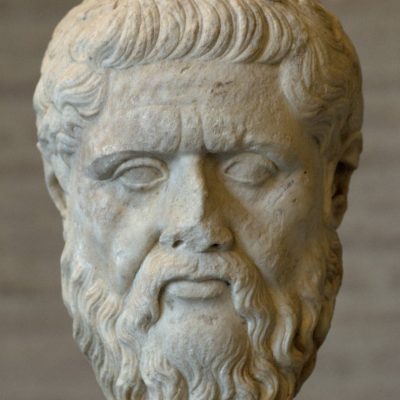
It is again the Timaeus which inspires Bemardus Silvestris, in his De Mundi universitate sive Megacosmus et Microcosmus, towards the middle of the century. A student of Bernard of Chartres, William of Conches (died in 1145), wrote a Commentary on the Timaeus and a Philosophia imbued with Platonism. It is noteworthy that, unlike Abelard, who also followed Plato, but who subordinated him and wanted him to serve Christian apologetics, the Platonists of Chartres expounded Platonism as an independent philosophy, without attempting any rapprochement with dogma and not without bringing a certain humanist fantasy and a concern for style that gives all the Chartres productions a very special flavor. This is, for example, the cosmogony of Bemardus Silvestris, a sort of mystery before the letter where we see Natura, all in tears, complaining to Noys, that is to say, to Providence, about the confusion that reigns in matter; Noys gives in to his complaints and separates the elements from one another (as in the first book of Ovid’s Metamorphoses); then Noys addresses Natura, promising to form man to complete his work, while Natura will form the body of man with the four elements (this is an adaptation of the story from the Timaeus). In appearance, it is the Christian Trinity in Platonic clothing; the father identical to the Good (Tagathon), the Son to Noys, the Spirit to the soul of the world or Endelechia which emanates from Noys; but the assimilation is illusory, since it is a question of hierarchical terms and not of equal persons, since the soul of the world still informs another hypostasis inferior to it, nature, since Noys finally does not resemble the incarnate Word in any way, but is an intelligible world, containing species, genus and individuals, “all that matter, the elements and the world will engender […], the whole series of destinies (fatalis seriés, this is the Stoic term), the disposition of the centuries, the tears of the poor and the fortunes of kings”[3].
Notes
[1] Jean de Salisbury, Metalogicus, III,
[2] Ibid., IV, 35.
[3] Cousin, Ouvrages inédits d’Abélard, p. 628.
Source: Émile Bréhier(1951). Histoire de la philosophie, Presses Universitaires de France. Translation and adaptation by © 2024 Nicolae Sfetcu

Philosophy of Blockchain Technology – Ontologies
Take the first step toward understanding the profound implications of blockchain technology.

The singularities as ontological limits of the general relativity
Discover the book that bridges the gap between science and philosophy! Explore the Uncharted Boundaries of the Universe.

Philosophy – Basic Notions, Volume 1
Begin your journey of wisdom. Philosophy isn’t just a subject; it’s a way of life.
Discover more from MultiMedia
Subscribe to get the latest posts sent to your email.




Leave a Reply