




How ordinary curved lenses focus light
A traditional convex lens focuses light because of refraction (bending of light at a curved interface). When parallel rays of light hit a curved lens:
- The curvature ensures that each part of the lens surface meets the incoming rays at a slightly different angle.
- Because light changes speed when entering a new medium (air → glass), the rays bend toward the lens’ optical axis.
- The geometry of the curvature is carefully designed so that all rays converge at a single focal point.
So: curvature + refraction = focusing.
Why a perfectly flat lens cannot do this
A flat slab of transparent material (like a glass window):
- Has parallel faces, so the light that enters at a given angle exits at the same angle.
- Each ray is shifted sideways (displaced), but its direction remains unchanged.
- Parallel rays remain parallel after passing through.
That means there’s no convergence or divergence — the rays never meet at a focal point.
In simple terms:
- A curved surface changes the direction of rays in a way that brings them together.
- A flat surface bends all rays equally (or not at all), so they don’t come together.
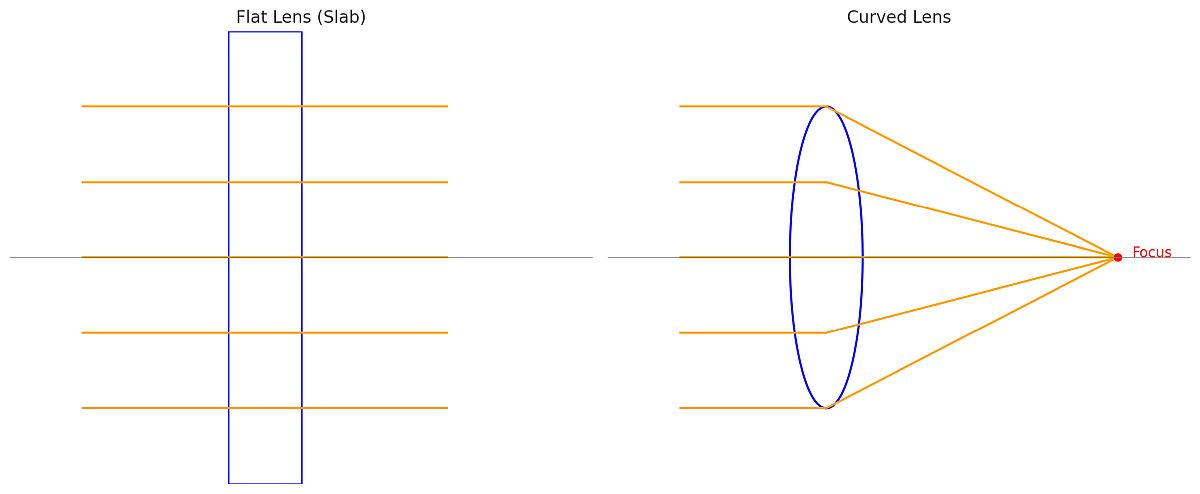
Comparing a flat slab and a curved lens:
– Left (Flat Lens/Slab): Rays stay parallel after passing through, only shifted sideways — no focusing.
– Right (Curved Lens): Rays bend toward the axis and converge at a focal point.
Important nuance: “Flat lenses” in modern optics
In physics research, people sometimes talk about “flat lenses” like metasurfaces or Fresnel zone plates. These are not truly simple slabs — they use nanostructures or diffraction to impose position-dependent phase shifts that mimic curvature. That way, even though the lens looks flat, it still effectively changes the direction of rays differently across its surface, achieving focus.
But a plain, uniform, flat piece of glass/plastic cannot do this.

Intelligence, from Natural Origins to Artificial Frontiers – Human Intelligence vs. Artificial Intelligence
Intelligence: redefining boundaries. Exploring human and artificial intelligence. Discover, learn, and envision the future.

Death – Cultural, philosophical and religious aspects
Discover the profound, multi-faceted exploration of death, one of humanity’s oldest and most universal topics.

COVID-19 Pandemic – Philosophical Approaches
Philosophy meets the pandemic to answer questions about humanity, society, and life itself.
Discover more from MultiMedia
Subscribe to get the latest posts sent to your email.





Leave a Reply