




Look up on a clear day and the sky stretches overhead in shades of blue. At sunset it burns orange and red; on cloudy days it turns white or gray. All of these colors come from the same sunlight interacting with Earth’s atmosphere. The key player is a process called Rayleigh scattering.

Sunlight and the air it travels through
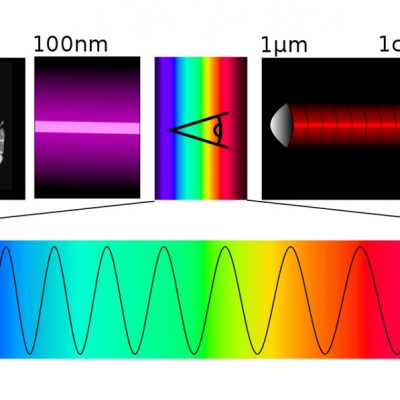
Sunlight looks white, but it’s really a blend of many colors—violet, blue, green, yellow, orange, and red—each with a different wavelength. As that light enters our atmosphere, it encounters tiny gas molecules (mainly nitrogen and oxygen) that are much smaller than the wavelengths of visible light.
Rayleigh scattering: blue gets bounced around
When light hits particles far smaller than its wavelength, it doesn’t pass straight through unchanged. Instead, the electric field of the light jiggles the molecules, which then re-radiate the light in all directions—this is Rayleigh scattering. Crucially, shorter wavelengths scatter much more strongly than longer ones: the intensity goes roughly as 1/λ41/\lambda^4. Because blue and violet light have shorter wavelengths than red and orange, they’re scattered far more.
From almost anywhere you look, the air is re-radiating lots of the sky’s short-wavelength light toward your eyes. That diffuse, directionless scattered light is what we perceive as the blue dome of the sky.
But isn’t violet even shorter than blue?
Good catch: by the math alone, violet should scatter more than blue. Two things nudge the result toward blue:
- Our eyes are less sensitive to violet than to blue; our “blue” cones peak in the blue range.
- The Sun emits slightly less violet than blue in the visible band, and the upper atmosphere (notably ozone) absorbs some violet and near-UV.
So the scattered light we actually perceive leans blue.
Why the Sun looks yellow—and sunsets go red
If more blue light is scattered out of the direct beam, the light that continues straight from the Sun to you is missing some blue. That makes the Sun (and the bright area around it) look a bit yellowish at midday.
At sunrise and sunset, sunlight has to pass through a much longer path in the atmosphere. Along the way, even more blue (and green) is scattered out, leaving the transmitted light enriched in reds and oranges. Meanwhile, the sky away from the Sun stays blue because scattered short wavelengths still reach you from other directions.
Why clouds are white (or gray)
Cloud droplets are much larger than the wavelength of light. That moves us out of Rayleigh scattering into Mie scattering, which is much less selective by color. All wavelengths are scattered roughly equally, mixing back into white. Clouds look gray when they’re thick enough that little light penetrates to the bottom, or when they sit under low ambient light.
Why the ocean is blue
Two effects contribute:
- Water absorbs red light more than blue, so blue penetrates and is reflected back more effectively.
- There’s also scattering by water molecules and tiny particles, but absorption differences are the main reason deep, pure water looks blue. (Shallow or sediment-rich water can look green or brown for the same reason—different absorption and scattering.)
Polarization: a photographer’s trick
Rayleigh-scattered light is partially polarized, especially about 90° from the Sun. That’s why a polarizing camera filter can darken the sky and make clouds pop—it selectively reduces that polarized scattered light.
Why space is black
No atmosphere, no scattering. With nothing to redirect sunlight into your line of sight, the sky of space stays black except where you look directly at the Sun or illuminated objects.
In short: tiny air molecules scatter shorter-wavelength light (blue/violet) far more than longer wavelengths. Our eyes and the Sun’s spectrum make that scattered light appear predominantly blue, painting the daytime sky. Different sizes and paths—cloud droplets, long sunrise air columns, water—shift the balance of scattering and absorption to give us the full daily palette.
Discover more from MultiMedia
Subscribe to get the latest posts sent to your email.





Leave a Reply