




At the heart of the interpretation of quantum mechanics are ideas like wavefunction collapse, the measurement problem, and the role of observers and probabilities. Let’s walk through what’s going on.
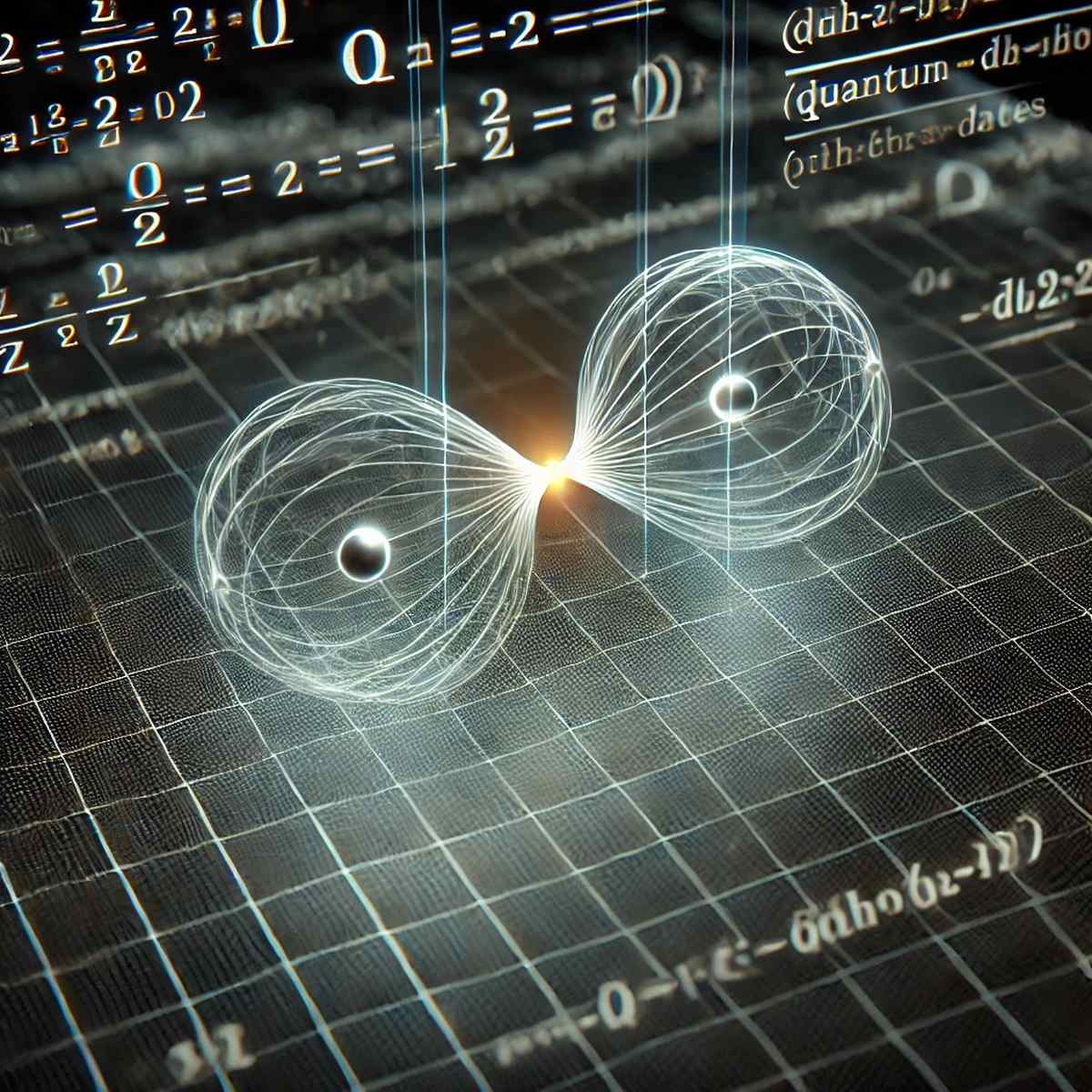
The formalism vs. the interpretation
Quantum mechanics has two layers:
The formalism (the math):
- A system is described by a wavefunction (\Psi), or more generally a state vector in a Hilbert space.
- The wavefunction evolves smoothly and deterministically according to the Schrödinger equation when no measurement is made.
- If you measure an observable (like position, spin, energy), the theory gives probabilities for different outcomes via the Born rule.
The interpretation (the story):
- What is the wavefunction? A real physical field? A book-keeping device for knowledge?
- What does it mean for it to “collapse” during measurement?
- When does a “measurement” really happen, and what counts as an “observer”?
- Why do we see a single definite outcome rather than superpositions?
The math works fantastically in practice. The interpretation is about what reality is like behind that math.
Wavefunction, superposition, and collapse
Superposition
In quantum mechanics, a system can be in a superposition of states. For example, an electron’s spin might be:
∣Ψ⟩ = α∣↑⟩ + β∣↓⟩
This doesn’t mean “the electron is really up or down and we just don’t know.” It means the state is genuinely both (in a precise mathematical sense) until a measurement is made.
Collapse (the textbook story)
According to the standard textbook (Copenhagen-like) rule:
- Before measurement:
∣Ψ⟩ = α∣↑⟩ + β∣↓⟩
- You measure spin along the (z)-axis.
- You get a definite outcome:
- With probability ∣α∣2: outcome “up” and the state jumps to ∣↑⟩
- With probability ∣β∣2: outcome “down” and the state jumps to ∣↓⟩
That sudden, random jump is called wavefunction collapse.
But this is weird, because:
- The Schrödinger equation predicts smooth, deterministic evolution.
- Collapse is sudden, probabilistic, and non-deterministic.
- The theory doesn’t clearly say when exactly collapse happens or what physically causes it.
That tension is the measurement problem.
The measurement problem in simple terms
Here’s the core issue:
- Quantum systems evolve linearly and stay in superpositions.
If you include the measuring device in the quantum description, the system-plus-device should also end up in a superposition, like:
(α∣↑⟩ + β∣↓⟩) ⊗ ∣ready⟩ → α∣↑⟩ ⊗ ∣↑⟩+β∣↓⟩⊗∣↓⟩
But in real life we never see superposed pointer positions.
We see one definite result: pointer up or pointer down. Never both.
So the measurement problem asks:
- Why don’t we see macroscopic superpositions (like Schrödinger’s cat being both alive and dead)?
- How exactly does the world of smooth quantum waves give rise to the definite, classical world we experience?
- Is collapse a real physical process, or just a convenient rule?
Decoherence: helpful but not the whole story
Modern discussions introduce decoherence:
- A quantum system is never really isolated; it interacts with its environment (air molecules, photons, the measuring device, etc.).
- These interactions make different parts of the superposition lose coherence with each other very fast.
- This makes superpositions practically unobservable and gives the appearance of classical, definite outcomes.
Decoherence explains:
- Why interference effects disappear once things get macroscopic.
- Why certain “pointer states” of macroscopic objects are stable and classical-like.
But decoherence alone doesn’t:
- Select one actual outcome; it just says branches don’t interfere anymore.
- Replace the Born rule; it doesn’t fully explain why we should assign probabilities (|\alpha|^2).
So even with decoherence, we still need an interpretation.
Main interpretations of quantum mechanics
Most interpretations keep the same experimental predictions (at least in ordinary situations) but tell different stories about what’s going on.
1 Copenhagen (textbook) interpretation
Very roughly:
- The wavefunction is a tool for predicting outcomes.
- There’s a split between:
- Quantum system (described by wavefunction),
- Classical measuring apparatus (described in ordinary terms).
- Measurement is a primitive notion:
- Before measurement: system has no definite value.
- During measurement: wavefunction collapses to an eigenstate.
- It’s often agnostic or modest about “what is really happening” between measurements.
Pros:
- Pragmatic and easy to use in practice.
- Matches how quantum mechanics is actually taught and used in labs.
Cons:
- Vague about what counts as a “measurement” or “classical” system.
- Collapse is not described by a clear physical mechanism.
- Many people find it conceptually unsatisfying.
2 Many-Worlds (Everett) interpretation
Key idea: There is no collapse. Only unitary evolution.
- The universal wavefunction always evolves smoothly according to the Schrödinger equation.
- Measurement causes the system + apparatus + observer to become entangled and branch into different “worlds” or “branches.”
- In one branch, you see outcome A; in another branch, a version of you sees outcome B.
So when you measure spin:
∣Ψ⟩ = α∣↑⟩ + β∣↓⟩
you + apparatus become:
α∣↑,“I saw up”⟩ + β∣↓,“I saw down”⟩
Each term corresponds to a different, non-interacting “world.”
Pros:
- No mysterious collapse — only the Schrödinger equation.
- Conceptually simple at the level of the math: just keep the formalism and take it literally.
Cons:
- You get an enormous (perhaps infinite) number of branches. What makes a “world” exactly?
- Interpreting probability is tricky: if all outcomes occur, what does it mean to say one is “probable”?
- Some find it extravagant or metaphysically heavy.
3 de Broglie–Bohm (pilot-wave / Bohmian mechanics)
Here, the wavefunction is real and there are actual particle positions:
- Particles always have definite positions in space.
- The wavefunction evolves by the Schrödinger equation.
- The wavefunction acts as a pilot wave, guiding particle trajectories via a deterministic guidance equation.
- Apparent randomness comes from ignorance of the exact initial conditions.
On measurement:
- There is no collapse of the wavefunction.
- But only one part of the wavefunction actually contains the particles (the rest is “empty” wave), so you see a single definite result.
Pros:
- Clear ontology: there are particles following definite paths.
- No special measurement postulate — just dynamics.
Cons:
- Explicitly nonlocal: what happens here can instantaneously depend on distant conditions.
- Extending the theory to relativistic quantum field theory is nontrivial.
- Many physicists find it unfamiliar or less natural than the standard formalism.
4 Objective collapse theories (GRW, CSL, etc.)
Here, collapse is real and built into the laws of physics:
- The wavefunction usually evolves according to Schrödinger.
- But occasionally, at random times, it undergoes a genuine spontaneous localization (“collapse”).
- The collapse is:
- Very rare for microscopic systems,
- Very frequent for macroscopic ones (because many particles are involved).
This way:
- Microscopic systems can show interference and quantum weirdness.
- Macroscopic systems rapidly collapse into definite states, so we don’t see cats in superpositions.
Pros:
- Gives a clear dynamical mechanism for collapse.
- Potentially testable: tiny deviations from standard quantum predictions at certain scales.
Cons:
- Requires adding new parameters and dynamics beyond standard quantum mechanics.
- Some versions may conflict with exact conservation laws or relativistic invariance (depending on details).
5 Information-based interpretations (QBism, relational QM, etc.)
These interpretations shift focus from “what the world is” to “what quantum states represent.”
QBism (Quantum Bayesianism)
- The wavefunction does not describe an objective physical state.
- It encodes an individual agent’s degrees of belief about possible measurement outcomes.
- Measurement updates are just Bayesian updates of personal probabilities.
Relational quantum mechanics
- Properties of a system are meaningful only relative to another system (like an observer or apparatus).
- There is no single “God’s-eye” state of the world, only relational facts.
Pros:
- Avoids some paradoxes by refusing to treat the wavefunction as a literal physical thing.
- Emphasizes the operational, information-theoretic character of quantum experiments.
Cons:
- Some find it unsatisfying because it seems to make reality depend on observers or agents.
- Ontology (“what really exists”) is often left intentionally vague or relational.
So what is the interpretation of quantum mechanics?
There is no single, universally accepted answer. The main points to keep in mind are:
- The core math is shared.
Nearly all interpretations use:
-
- Wavefunctions/state vectors,
- Unitary evolution via Schrödinger,
- Born rule probabilities (at least effectively).
- They differ in the story around that math:
- Is the wavefunction real, or just information?
- Does collapse really happen, or is it an illusion?
- Are there hidden variables (like particle positions)?
- Does the universe constantly branch into many worlds?
- Most interpretations are empirically equivalent (so far).
They agree on all standard experiments. Objective collapse theories are the main class that could, in principle, be tested and distinguished.
- The measurement problem is the central puzzle.
Any interpretation must somehow explain:
-
- Why we see definite outcomes,
- Why probabilities follow the Born rule,
- How the classical world emerges from the quantum formalism.
Where things stand today
In practice:
- Working physicists often don’t worry much about interpretation day-to-day; they use the standard rules to calculate and compare with experiment.
- Philosophers of physics and some theoretical physicists actively debate and refine interpretations.
- Decoherence has become a standard ingredient in almost all modern discussions.
- New experiments and ideas (e.g., tests of collapse models, quantum gravity, quantum information approaches) might eventually favor one line of thought over others — but that hasn’t happened yet in a decisive way.
Short summary
- The interpretation of quantum mechanics is about what the formalism means.
- Wavefunction collapse is the rule that says the state suddenly jumps to match a measurement outcome — and this clashes with smooth Schrödinger evolution.
- The measurement problem is the puzzle of how definite outcomes arise from a theory built on superpositions and linear evolution.
- Different interpretations offer different answers:
- Copenhagen: collapse is real but primitive and linked to measurement.
- Many-Worlds: no collapse; all outcomes occur in branching worlds.
- Bohmian mechanics: particles have definite positions guided by a wave.
- Objective collapse: collapse is a genuine physical process.
- Information-based views: the wavefunction encodes knowledge or relations, not an objective wave.

Epistemology of experimental gravity – Scientific rationality
Explore the depths of gravitational theory and its evolution, framed through the groundbreaking methodology of Imre Lakatos.

Solaris, directed by Andrei Tarkovsky – Psychological and philosophical aspects
Discover the interplay of psychology, philosophy, and cinema in one of the greatest cinematic masterpieces of all time.

The Role of Social Media in Democracy, New Public Management and e-Governance
A vital resource for anyone interested in understanding the evolving intersection between technology and government.
Discover more from MultiMedia
Subscribe to get the latest posts sent to your email.


Leave a Reply