




“Negative temperature” sounds like being colder than absolute zero—but in physics it means something very different. It refers to special systems where the thermodynamic temperature, defined from entropy, can take negative values. Paradoxically, these systems are hotter than any positive temperature: if you put one in contact with an ordinary hot object, heat flows from the negative-temperature system to the positive-temperature one.
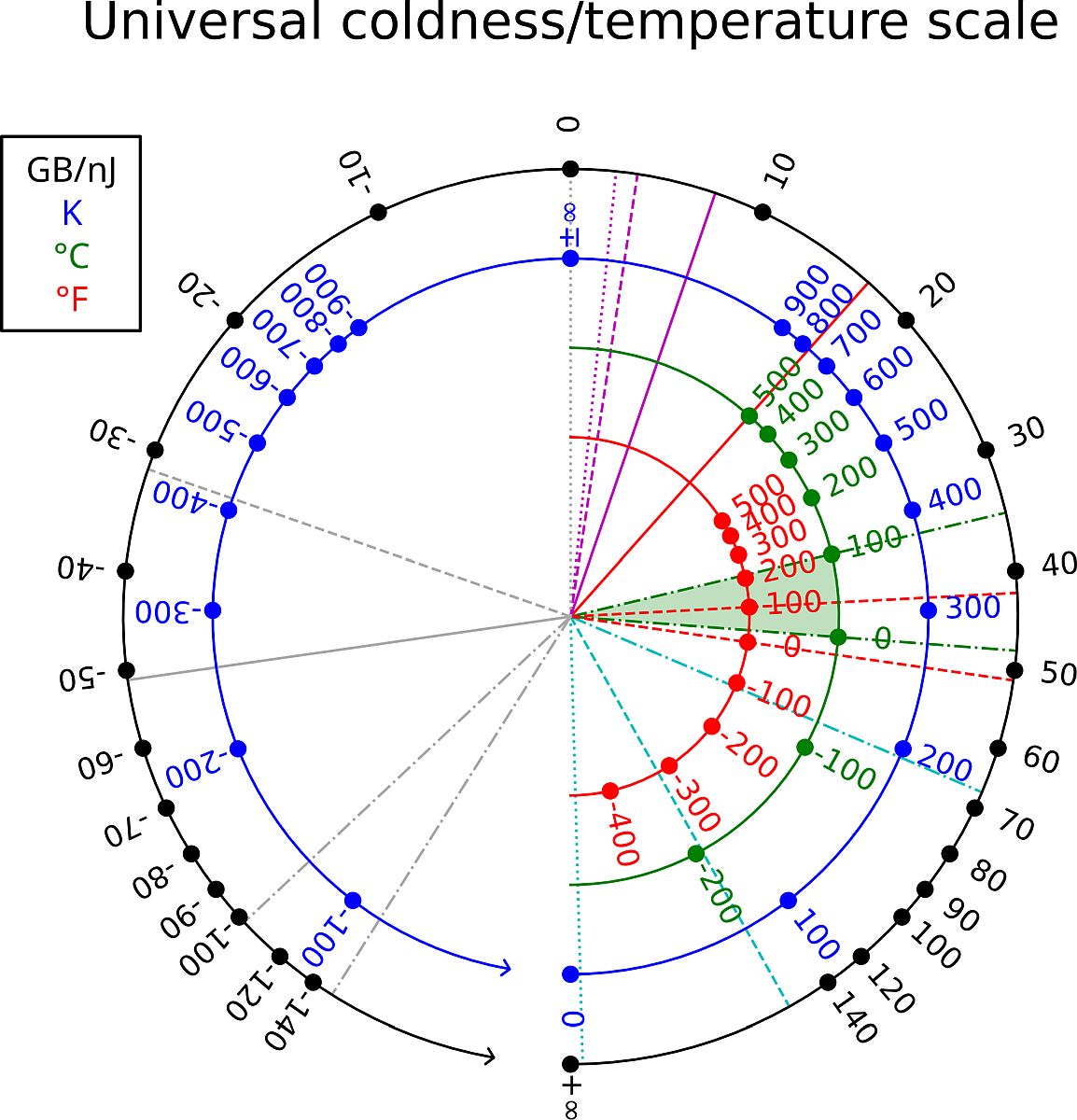
SI temperature/coldness conversion scale: Temperatures on the Kelvin scale are shown in blue (Celsius scale in green, Fahrenheit scale in red), coldness values in gigabyte per nanojoule are shown in black. Infinite temperature (coldness zero) is shown at the top of the diagram; positive values of coldness/temperature are on the right-hand side, negative values on the left-hand side.
The temperature you meet in thermodynamics (not the weather one)
In everyday life, temperature measures average kinetic energy: more jiggling means hotter. In thermodynamics and statistical mechanics, the rigorous definition is
1/T =(∂S/∂E)N,V,…
where (S) is entropy and (E) is energy.
- If adding energy increases the number of accessible microstates (entropy rises), then ∂S/∂E > 0 and T > 0.
- If, for some reason, adding energy reduces the number of accessible microstates, then ∂S/∂E < 0 and T < 0.
That second case is unusual but possible in carefully prepared systems.
How can entropy decrease when energy increases?
You need a system with an upper bound to its energy. A classic example is a collection of spins in a magnetic field. Each spin can be “down” (low energy) or “up” (high energy); there’s no state above “all spins up.” At low energies, adding energy lets more configurations become available, so entropy grows. But once you approach the top—most spins already up—adding more energy reduces the number of ways to arrange the system (you’re running out of states), so entropy falls. That flips the sign of (\partial S/\partial E) and therefore makes (T) negative.
The same idea shows up in the Boltzmann distribution:
p(E) ∝ e−E/kT.
For positive (T), higher-energy states are less populated. For negative (T), the exponent changes sign and higher-energy states are more populated—a “population inversion.”
Why negative temperature is “hotter than hot”
“Hotness” is about the direction of heat flow, which follows the sign of 1/T. Because 1/T is negative for T < 0, any negative-temperature system will dump heat into every positive-temperature system. In the usual ordering of hotness:
0 K < room temp < 1000 K < ∞ < hottest (T < 0)
So negative temperature isn’t “colder than absolute zero”; it’s beyond infinity on the hot side.
What’s required to make negative temperatures?
To realize and briefly maintain a negative temperature, a system must:
- Have a bounded energy spectrum. There must be a hard upper limit to energy (e.g., two-level spins, atoms in a lattice band).
- Be isolated well enough that it internally re-equilibrates faster than it exchanges energy with the environment.
- Be driven into a population inversion (more particles in high-energy states than low-energy ones).
- Have limited, controllable degrees of freedom. Ordinary gases with unbounded kinetic energy can’t do this.
Real examples
- Nuclear spin systems in solids. The first demonstrations (1950s) flipped spin populations using magnetic fields and radiofrequency pulses, creating negative spin temperatures for the spin subsystem (the lattice remained at positive temperature).
- Lasers. A gain medium is pumped so that excited states are more populated than ground states—a population inversion describable as a negative temperature of the relevant two-level system.
- Ultracold atoms in optical lattices. By shaping the potential and interactions so the accessible kinetic energy is bounded (e.g., within a lattice band) and then inverting populations, researchers have realized negative temperatures for motional degrees of freedom.
In all cases, the negative-(T) state is metastable and exists only for a limited time before relaxing back to ordinary conditions.
Thermodynamics with T < 0: odd but consistent
- Heat flow: Always from T < 0 to T > 0.
- Engines: A Carnot engine operating between a negative-T hot reservoir and a positive-T cold reservoir can have an efficiency formally exceeding 100% when written as (because (Thot < 0)). This doesn’t break physics: the “excess” work comes from depleting the inverted population, not creating energy from nothing.
- Stability: Negative-T states are stable only under the special constraints above; remove the constraints and they quickly unwind toward positive temperatures.
Common misconceptions
- “Negative temperature is colder than 0 K.” No—negative temperature systems are hotter than any positive temperature.
- “It’s the same as −10 °C in weather.” Not at all. Celsius can be negative while Kelvin is positive; negative absolute temperature is a separate thermodynamic concept.
- “Any system can have (T<0).” Only systems with an upper energy bound and fast internal equilibration can.
- “It violates the second law.” It doesn’t; the second law is satisfied when entropy and energy bounds are treated correctly.
Bottom line
A negative temperature is a well-defined thermodynamic state of certain constrained systems with population inversion and a bounded energy spectrum. It is not colder than absolute zero—it’s a regime where adding energy reduces entropy, making the system effectively hotter than infinity.

EU Translation Guide
Write Clearly. Translate Effectively. Communicate with Impact.

Big Data Ethics in Research
A critical exploration of the ethical challenges and legal implications associated with Big Data.

Web 2.0 / Social Media / Social Networks
Unlock the Power of Digital Connection
Discover more from MultiMedia
Subscribe to get the latest posts sent to your email.


Leave a Reply