




The four players form two partnerships:
- North–South, abbreviated N–S;
- East–West, abbreviated E–W.
Partners always sit opposite one another. North is South’s partner, and East is West’s partner.
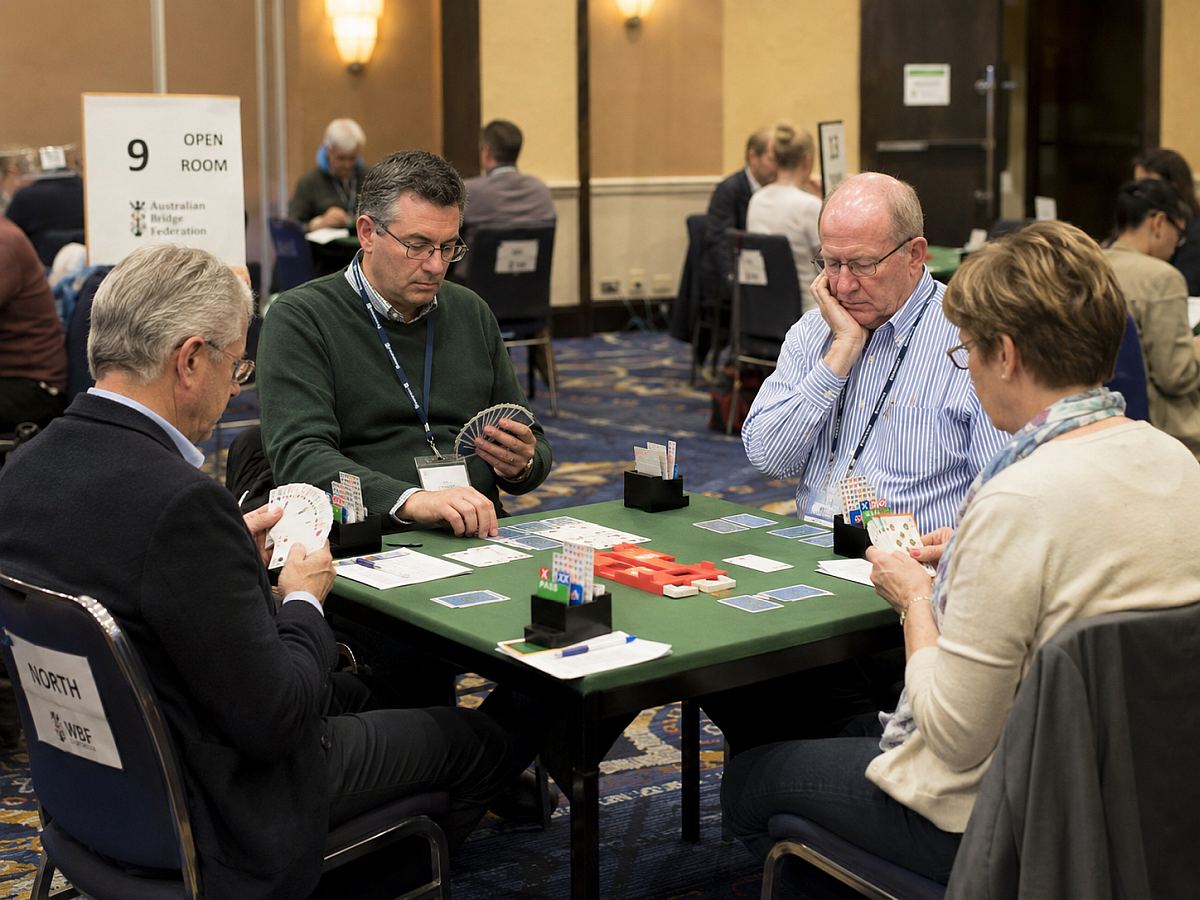
Players sitting next to one another are opponents. For South, East and West are the opponents. The same is true from North’s perspective. The members of a partnership pursue the same result, and the score belongs to the partnership rather than to one individual player.
This structure distinguishes bridge from many other card games. A player does not act only on their own behalf. Every call and every card played must also take the partner into account.
Partners are not allowed to show each other their cards or communicate through words, gestures, facial expressions, or deliberate changes in tempo. Information must be conveyed only through methods permitted by the laws of bridge.
During the auction, communication takes place through calls. Each call has a meaning defined by the bidding system used by the partnership.
For example, an opening bid of 1♠ may show, in a particular system, a hand of a certain strength containing at least five spades. Partner must interpret the bid according to the agreed system, not through gestures or personal assumptions.
Partnership agreements must be clear and understood by both players. If one partner believes that a bid has one meaning while the other interprets it differently, costly misunderstandings may occur.
Suppose North opens 1♥. South must know what this bid promises:
- how many hearts are required;
- what minimum strength is shown;
- what types of hand may be included.
If North believes that the opening promises at least five hearts, while South thinks it may also be made with only four hearts, the partnership may choose the wrong contract.
For this reason, it is important to have a bidding system. A system is the set of rules and agreements by which partners describe their hands.
For beginners, the system should be simple. A large number of conventions does not guarantee good results. It is more important for both partners to understand a few basic rules correctly.
The partnership remains important after the auction has ended.
The partnership that wins the auction tries to make the contract. One member becomes the declarer, while the other becomes the dummy.
Declarer controls the play of both partnership hands after dummy’s cards are placed face up on the table. Dummy does not decide which cards to play. Dummy simply plays the card named by declarer.
The opposing partnership consists of the two defenders. Their aim is to prevent declarer from making the contract.
During the defense, partnership cooperation is just as important as it is during the auction. The defenders cannot see each other’s cards and must cooperate on the basis of the available information.
They may infer what partner holds from:
- the calls made during the auction;
- the opening lead;
- the cards already played;
- the cards visible in dummy;
- permitted defensive signals.
Partners must trust one another. If one defender indicates, through an agreed signal, that a suit should be continued, the other defender should take that information into account whenever the situation allows.
Nevertheless, no system can eliminate mistakes completely. Partners may judge a position differently, forget a convention, or choose the wrong card. Such errors are part of the learning process.
A fundamental principle of bridge is respect for partner. Criticizing partner during the game does not help the partnership and may damage concentration. Analysis should take place after the deal and preferably after the round or tournament has ended.
An appropriate question would be:
“What information could we have conveyed more clearly in this situation?”
An inappropriate remark would be:
“How could you possibly play such a card?”
The first question aims to improve the partnership. The second turns a bridge problem into a personal criticism.
At bridge, the partnership wins and loses together. Even when one player makes the mistake, the result belongs to both partners.
Discover more from MultiMedia
Subscribe to get the latest posts sent to your email.





Leave a Reply